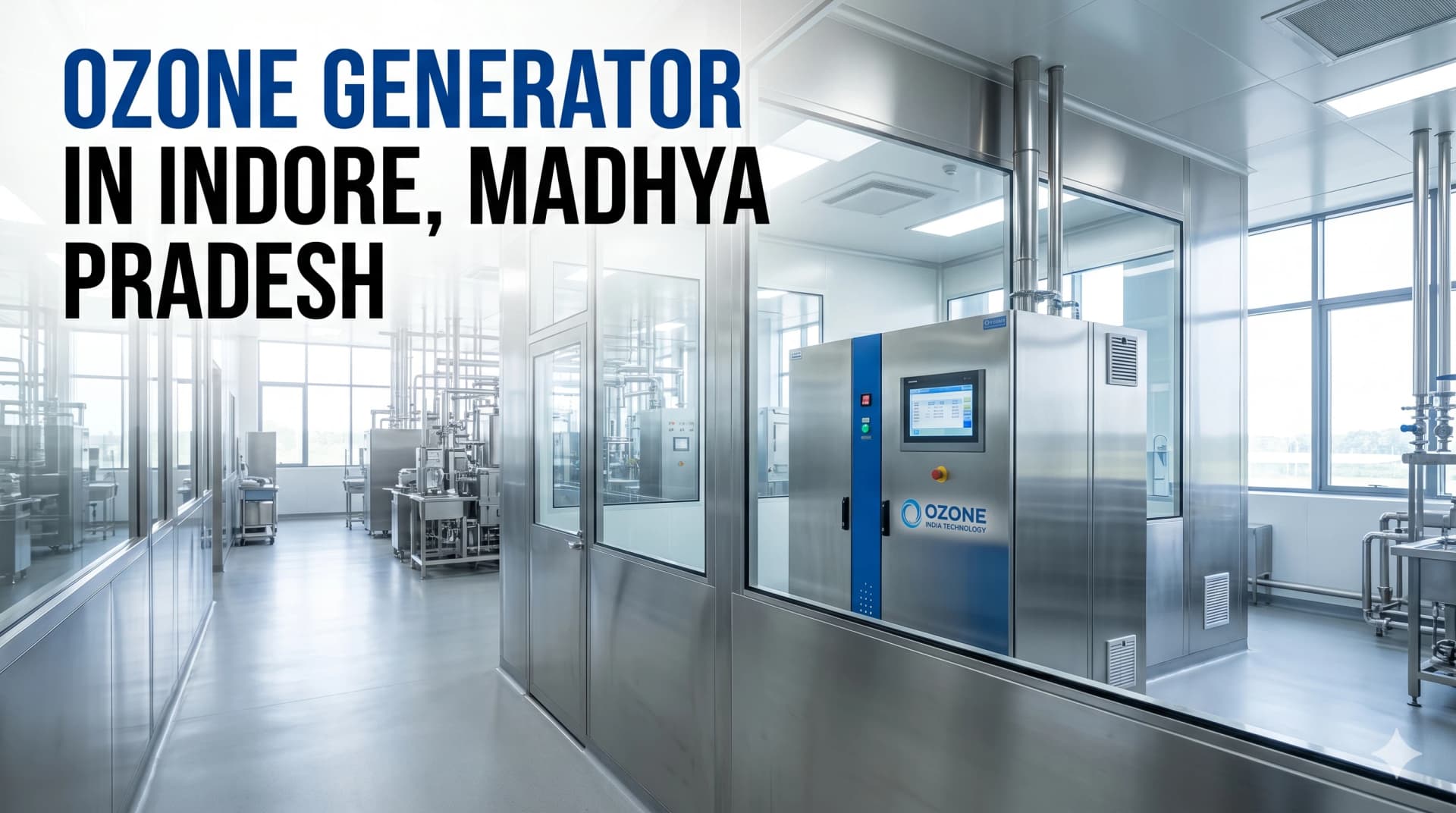
Ozone Generator in Indore, Madhya Pradesh serves India's cleanest city (11-time Swachh Survekshan winner) — a distinction that creates unusually high expectations for industrial effluent compliance from the MPPCB (Madhya Pradesh Pollution Control Board) and from the Indore Smart City Mission's advanced water management infrastructure. Indore's industrial base — centred on Pithampur AURIC industrial zone (one of India's first automated industrial corridors), the Sanwer Road industrial belt and the specialty food processing sector — generates pharmaceutical, automotive, soyabean and food processing effluent streams requiring advanced treatment. Ozone India Technology — India's CE-certified, ISO 9001:2015 manufacturer of industrial ozone generators — supplies factory-direct ozone systems to Indore with same-week delivery and complete MPPCB compliance documentation. Contact our team at +91 96500 17943.
Water and Industrial Challenges in Indore
Indore — Madhya Pradesh's commercial capital with 3.3 million people — draws its water primarily from Narmada River via the Indore-Dewas-Ujjain Regional Water Supply Scheme and from the Yeshwant Sagar (Bilawali Lake) reservoir. The Khan River — Indore's historically important urban waterway — was declared virtually dead in its urban stretch due to untreated sewage and industrial discharge. The Rs 320 crore Khan River Rejuvenation Project (2019 to 2024) has constructed interceptor sewers, pumping stations and upgraded STPs, restoring base flow, but advanced tertiary treatment is needed to meet Class B river standards in the restored river segments.
Pithampur AURIC — Asia's first automated industrial corridor — houses 300-plus manufacturing units in automotive, pharmaceutical, electronics and consumer goods sectors spread across 8,000 acres. MPPCB enforces strict consent conditions on Pithampur units, with online monitoring and quarterly audits. Pharmaceutical units (Cipla Goa Plant has operations near Indore, Alembic, Emami) require WHO GMP purified water for API manufacturing and formulation. Automotive units (Force Motors, Johnson Controls India, Motherson Group) require industrial process water treatment for paint shop effluent, machining coolant and cooling water.
Indore is India's soyabean processing capital — Madhya Pradesh produces 30 to 35 percent of India's soyabean crop, and Indore houses 50-plus soyabean oil extraction and processing facilities. Soyabean oil extraction effluent (from hexane extraction and degumming) contains high BOD (3,000 to 8,000 mg/L), COD (8,000 to 20,000 mg/L) and hexane residuals that biological treatment alone cannot reduce to MPPCB discharge limits. Ozone-AOP combined with biological treatment achieves MPPCB-compliant BOD below 30 mg/L and COD below 250 mg/L from soyabean effluent.
Devi Ahilya Vishwavidyalaya (DAVV) and the growing IIT Indore campus represent large institutional water users. IT parks (TCS, Infosys, WNS Indore) require campus STP operation meeting MPPCB norms for treated sewage reuse in landscaping and toilet flushing — a requirement that ozone tertiary disinfection satisfies more reliably than chlorination.
How Ozone Technology Addresses Indore's Challenges
For Khan River rehabilitation STPs, ozone tertiary treatment at 5 to 8 mg/L achieves Class B river parameters (BOD below 30 mg/L, coliform below 5,000 MPN/100 mL) that activated sludge alone cannot consistently meet — especially during winter low-temperature periods when biological treatment efficiency drops significantly. Real-time dissolved ozone monitoring with automatic dosing maintains consistent performance across Indore's seasonal temperature range of 5°C (January) to 45°C (May).
For Pithampur pharmaceutical purified water, ozone at 0.05 to 0.2 mg/L in purified water loops continuously destroys biofilm and maintains WHO GMP bioburden below 100 CFU/mL. Ozone sanitisation also prevents Pseudomonas aeruginosa biofilm formation — the most common WHO Schedule M violation in Indian pharma purified water systems.
For soyabean processing effluent, ozone at 15 to 20 mg/L oxidises refractory hexane metabolites and degumming chemical residuals — reducing COD by 60 to 80 percent and enabling biological SBR to achieve MPPCB-compliant final discharge. The payback on ozone for soyabean ETP is typically 12 to 18 months through elimination of MPPCB fines and reduced chemical treatment costs.
Khan River Indore — Seasonal Water Quality Improvement (mg/L BOD)
Key Applications in Indore
Pharmaceutical Purified Water — Pithampur AURIC
Pithampur's 300-plus manufacturing units include major pharma producers requiring WHO GMP water. Ozone India Technology supplies 2 to 10 g/hr pharmaceutical-grade ozone sanitisation systems with complete Schedule M documentation. Factory-direct delivery from Ghaziabad to Pithampur in 24 hours.
Soyabean Processing ETP — Sanwer Road and Scheme 54
Soyabean oil extractors require BOD and COD reduction from hexane extraction and degumming effluent. Ozone India Technology supplies 20 to 100 g/hr industrial ozone generators for soyabean ETP tertiary treatment, integrated with biological SBR to achieve MPPCB-compliant discharge.
Campus STP — IIT Indore, DAVV, IT Parks
Campus STPs for IIT Indore, DAVV and TCS/WNS IT campuses need treated sewage reuse for landscaping. Ozone tertiary treatment at 5 mg/L achieves CPCB's Sewage Treatment Standard — BOD ≤ 10 mg/L, coliform ≤ 100 MPN/100 mL — enabling safe reclaimed water use.
Municipal Smart City Water — Indore Smart City Mission
Indore Smart City Mission's advanced water management initiative includes real-time monitoring of water distribution networks. Ozone India Technology supplies smart ozone treatment systems compatible with IoT monitoring platforms — aligned with Indore's digital-first approach to urban infrastructure.
Why Indian-Manufactured Ozone Technology Suits India
Our Ghaziabad facility is 800 km from Indore (12 to 14 hours by road on NH3/NH52 or 10 hours by Avantika Express). In-stock systems delivered in 24 hours. MPPCB-aligned documentation. CE-2621A and ISO 9001:2015 accepted by all Indian regulators. Factory-direct pricing 30 to 40 percent below European brands.
Compliance and Standards in Indore
MPPCB enforces CPCB Schedule I standards. Khan River restoration requires Class B discharge (BOD ≤ 30 mg/L, coliform ≤ 5,000 MPN/100 mL). Pithampur Red Category pharma units require OCEMS. FSSAI governs soyabean oil and food processing water.
Pithampur AURIC — Industrial ETP Compliance Rate by Technology (%)
Frequently Asked Questions
What is the distance from Ozone India Technology's Ghaziabad facility to Indore?
Approximately 800 km by road (via NH3/Agra-Bombay Highway) — 12 to 14 hours by truck freight. In-stock systems are delivered to Pithampur or Sanwer Road industrial areas within 24 to 36 hours.
Can ozone handle Indore's extreme summer temperatures (45°C)?
Yes. Our corona discharge generators are rated for 45°C ambient operation with automatic thermal protection. Air dryers use desiccant beds rated for 0 to 45°C — preventing corona cell damage from moisture at both high temperature and winter humidity extremes.
Does ozone help soyabean processors meet MPPCB's hexane discharge limit?
Yes. Trace hexane metabolites (cyclohexane, benzene precursors) in soyabean extraction effluent are refractory to biological treatment but are destroyed by ozone at 15 mg/L dose. Ozone India Technology provides free COD and hexane residual analysis consultation for Indore soyabean processors.
What is the typical payback for an ozone system in Indore?
For pharma purified water (replaces daily chemical sanitisation): 18 to 24 months. For soyabean ETP (eliminates MPPCB fines + reduces chemical costs): 12 to 18 months. For campus STP reuse (reduces freshwater procurement for irrigation): 12 to 24 months.
How to Get an Ozone System for Indore
Contact us:
- Phone / WhatsApp: +91 96500 17943
- Email: [email protected]
Free application assessment and factory-direct quotation within 2 hours. On-site visits to Indore available within 48 hours.