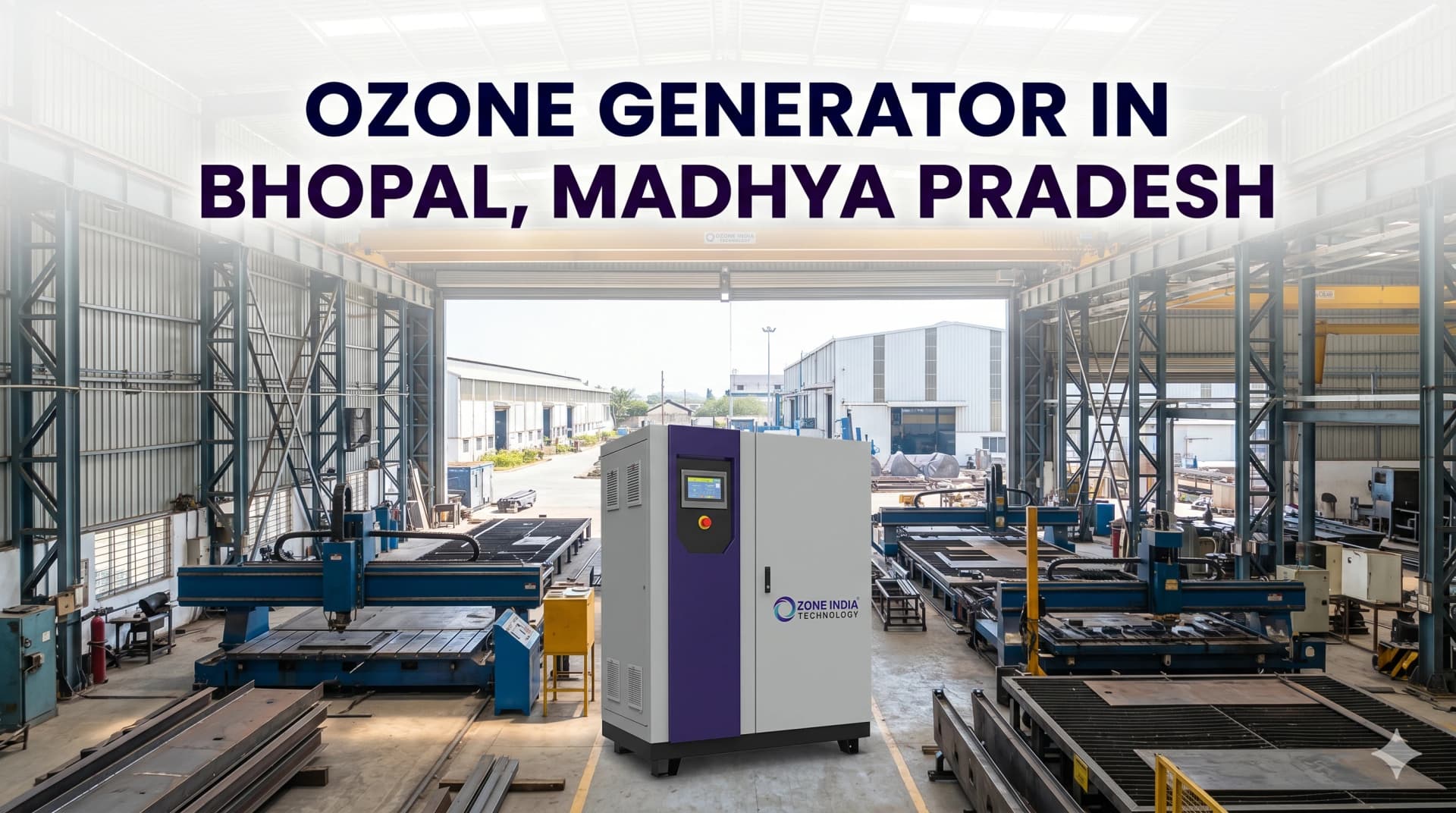
Ozone Generator in Bhopal, Madhya Pradesh addresses the unique water treatment challenges of India's "City of Lakes" — where the millennium-old Upper Lake (Bada Talab), one of Asia's largest urban freshwater lakes and Bhopal's primary drinking water source, faces progressive deterioration from algal blooms, nutrient loading and emerging contaminants that conventional water treatment at the Bhopal Municipal Corporation's waterworks cannot fully address. Simultaneously, the Mandideep and Govindpura industrial zones house pharmaceutical manufacturers, IT campuses and engineering facilities requiring WHO GMP-compliant purified water and MPPCB-compliant ETP discharge. Ozone India Technology — India's CE-certified, ISO 9001:2015 manufacturer of industrial ozone generators — is headquartered in Greater Noida and delivers factory-direct ozone water treatment systems to Bhopal in 24 to 36 hours. Call +91 96500 17943 for a free consultation.
Water and Industrial Challenges in Bhopal
Bhopal's Upper Lake (Bada Talab) — a 31 km² reservoir built by Raja Bhoj in 1010 AD — supplies approximately 40 percent of Bhopal's drinking water to 2.3 million residents through the BMC's (Bhopal Municipal Corporation) filtration and chlorination plant at Kaliasot. The lake has experienced progressively worsening algal bloom events since the 2000s, driven by nutrient (nitrogen and phosphorus) loading from the 360 villages, 45 drains and 5 significant streams in its 361 km² catchment. Cyanobacterial blooms (particularly Microcystis aeruginosa) produce microcystin toxins detectable in treated tap water during peak bloom periods — a fact documented by CPCB and Madhya Pradesh state research institutions. Conventional chlorination does not destroy microcystins; ozone pre-treatment at 1 to 2 mg/L destroys >95 percent of microcystin-LR in 10 minutes of contact time.
The Bhopal gas tragedy legacy site — the former Union Carbide (now Dow Chemical) plant near Hamidia Road — represents a contaminated groundwater challenge unique to Bhopal. NGERI (National Geophysical Research Institute) surveys confirm chlorinated solvent contamination (carbon tetrachloride, chloroform, chlorobenzenes) in a groundwater plume affecting parts of Bhopal's densely populated northern areas. While ozone alone cannot treat deep aquifer contamination, ozone-AOP (ozone + hydrogen peroxide) is a proven technology for chlorinated solvent destruction in groundwater pump-and-treat systems.
Mandideep Industrial Zone (30 km from Bhopal on NH-12) hosts 200-plus manufacturing units including pharmaceutical (Cipla, Alembic, RPG Life Sciences), chemicals, food processing and IT. MPPCB enforces consent-to-operate conditions requiring OCEMS for Red Category pharma units. WHO GMP Schedule M purified water requirements create strong demand for ozone sanitisation systems in Mandideep's pharmaceutical cluster.
AIIMS Bhopal — one of India's premier medical institutions established in 2012 — and Hamidia Hospital (government, 1,500 beds) represent major healthcare sector ozone users requiring sterile water for CSSD, surgical instruments and pharmaceutical preparation rooms.
How Ozone Technology Addresses Bhopal's Challenges
For Upper Lake source water, ozone pre-treatment at 1 to 2 mg/L before coagulation achieves simultaneous microcystin destruction (>95 percent), taste-and-odour control (geosmin and 2-MIB reduction >90 percent), reduction of algal bloom organic matter loading and improved coagulation efficiency. This reduces alum and polyelectrolyte consumption by 20 to 30 percent while dramatically improving the safety and palatability of Bhopal's drinking water — especially critical during peak bloom months (September to November).
For Mandideep pharma purified water, ozone at 0.05 to 0.2 mg/L in water loops continuously destroys biofilm and maintains WHO GMP bioburden below 100 CFU/mL, eliminating daily chemical sanitisation and the risk of Pseudomonas biofilm formation that causes Schedule M failures.
For MPPCB-mandated ETP compliance at Mandideep's chemical and engineering units, ozone at 10 to 20 mg/L achieves MPPCB-compliant BOD below 30 mg/L and COD below 250 mg/L from industrial effluent after biological primary treatment.
Upper Lake Bhopal — Algal Bloom Severity and Microcystin Levels (µg/L, 2018-2023)
Key Applications in Bhopal
Upper Lake Drinking Water — BMC Waterworks
BMC's Kaliasot filtration plant draws Upper Lake water for treatment. Ozone pre-treatment at 1 to 2 mg/L would address algal toxins, geosmin/MIB taste-and-odour and emerging contaminants — improving drinking water quality for 2.3 million Bhopal residents during annual bloom seasons.
Pharmaceutical Purified Water — Mandideep Industrial Zone
Mandideep's pharmaceutical cluster requires WHO GMP water continuously. Ozone India Technology supplies 2 to 10 g/hr purified water sanitisation systems with Schedule M documentation. 24 to 36 hour delivery from Ghaziabad to Mandideep.
Hospital Water — AIIMS Bhopal and Hamidia Hospital
AIIMS Bhopal (800-bed teaching hospital) and Hamidia Hospital require sterile water for CSSD, OT and pharmaceutical preparation. Ozone India Technology supplies compact 2 to 5 g/hr hospital ozone systems with NABH-compatible documentation.
Legacy Site Groundwater — Bhopal Union Carbide Area
Chlorinated solvent-contaminated groundwater from the legacy site requires pump-and-treat with ozone-AOP technology. Ozone India Technology provides technical feasibility consultation for contaminated groundwater remediation projects in Bhopal.
Why Indian-Manufactured Ozone Technology Suits India
Ghaziabad to Bhopal: 750 km (10 to 12 hours by road via NH-12 Agra-Bombay Highway or Bhopal-Delhi NH-12 route). In-stock systems delivered in 24 to 36 hours. CE-2621A and ISO 9001:2015 accepted by MPPCB, BMC, AIIMS and all regulatory bodies. Factory-direct pricing 30 to 40 percent below European alternatives.
Compliance and Standards in Bhopal
MPPCB Bhopal enforces CPCB Schedule I standards and site-specific consent conditions. AIIMS NABH accreditation requires sterile water standards. BMC water quality follows BIS IS 10500:2012 for drinking water. Upper Lake is a designated Ramsar Wetland candidate — environmental sensitivity heightens compliance expectations.
Bhopal Industrial Zone ETP Technology — Compliance Rate with MPPCB Standards (%)
Frequently Asked Questions
Can ozone destroy microcystin toxins in Upper Lake drinking water?
Yes. Ozone at 1 to 2 mg/L achieves >95 percent microcystin-LR destruction in 10 minutes — below WHO guideline of 1 µg/L. Ozone also destroys geosmin and 2-MIB (earthy/musty odour compounds) at >90 percent efficiency. This makes ozone pre-treatment the most effective single step for addressing Upper Lake algal bloom water quality impacts.
What is delivery time from Ghaziabad to Bhopal?
24 to 36 hours by road freight (750 km). For urgent installations, our engineering team can accompany the system delivery for immediate commissioning.
Does ozone help with chlorinated solvent contamination from the Bhopal gas tragedy legacy site?
Ozone-AOP (ozone combined with hydrogen peroxide at molar ratio 0.5) destroys chlorinated solvents including carbon tetrachloride, chloroform and 1,2-dichloroethane at 80 to 99 percent efficiency in pump-and-treat groundwater remediation systems. Contact us for a free technical consultation on legacy site remediation.
Can ozone treat the effluent from Bhopal's IT campuses?
Campus STP effluent from IT parks in Bhopal (including TCS, Wipro, Infosys offices) typically has BOD 150 to 250 mg/L from canteen and toilet waste. Ozone tertiary treatment at 5 to 8 mg/L after SBR produces reuse-quality effluent (BOD ≤ 10 mg/L, coliform ≤ 100 MPN/100 mL) for campus landscaping and toilet flushing.
How to Get an Ozone System for Bhopal
Contact us:
- Phone / WhatsApp: +91 96500 17943
- Email: [email protected]
Free application assessment, MPPCB-aligned sizing and quotation within 2 hours.