
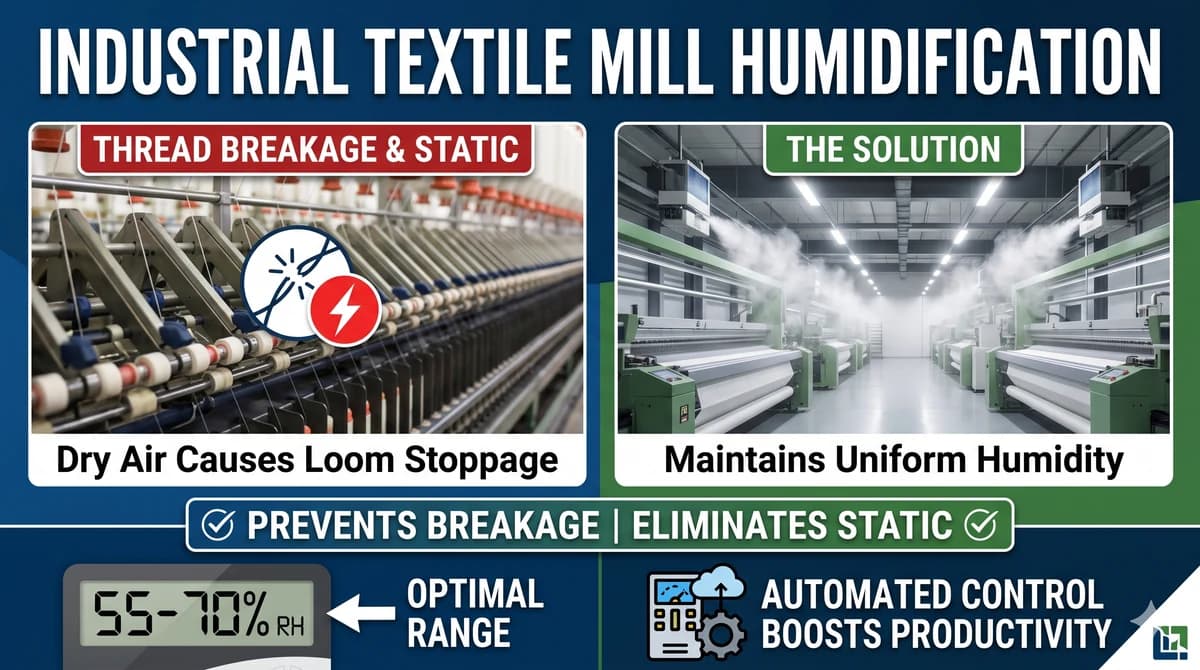
Industrial Humidifier in Textile Mill
Ultrasonic humidification for spinning, weaving, and finishing — 65–75% RH for zero yarn breakage
THE NEED
Why Textile Mill?
65-75%
RH required for cotton spinning and weaving
30%
yarn breakage increase at <55% RH
2-3%
weight loss in cotton at <50% RH (revenue loss)
Zero
static charge issues with proper humidification
25%
productivity gain with correct humidity in mill
ATIRA
recommends 65-70% RH for ring spinning
OVERVIEW
What is Textile Mill?
Textile manufacturing is the most humidity-sensitive large-scale industrial process in India — a sector where a 10% drop in relative humidity translates directly into measurable yarn breakage increases, fibre weight losses, and static-electricity defects across all production departments. India is the world's second-largest textile producer, with an industry valued at over ₹9 lakh crore comprising spinning, weaving, knitting, and processing operations concentrated in Ludhiana (Punjab), Coimbatore and Tiruppur (Tamil Nadu), Surat (Gujarat), Bhilwara (Rajasthan), and Erode (Tamil Nadu). The industrial humidifier for textile mill is the process control instrument that maintains relative humidity within the ranges specified by ATIRA (Ahmedabad Textile Industry Research Association) and SITRA (South India Textile Research Association) — 60–70% RH in spinning sections, 65–75% RH in weaving departments, and 55–65% RH in knitting units — ranges that are not engineering preferences but direct determinants of fibre tensile strength, yarn cohesion, and electrostatic behaviour as documented in decades of published textile science research.
The physics of fibre moisture absorption is the foundational science behind the industrial humidifier for textile mill. Natural fibres — cotton, wool, jute, and viscose rayon — are hygroscopic polymers whose molecular structure (cellulose's hydroxyl groups in cotton; keratin's amide linkages in wool) forms hydrogen bonds with atmospheric water vapour. The moisture regain of cotton at 65% RH is 8.5% (international standard per ISO 139:2005 and BIS IS:1060 Part 1) — meaning 100 grams of dry cotton fibre absorbs 8.5 grams of water at the standard atmosphere. At 45% RH, the same cotton fibre has moisture regain of only 5.5% — a difference of 3 grams per 100 grams dry weight. This 3% moisture difference is not abstract: it directly reduces the tensile strength of each fibre by approximately 18–22% (Kothari and Anandjiwala, ATIRA Research Journal, Vol. 15, 1975), reduces inter-fibre cohesion in the yarn structure, and dramatically increases the probability of fibre breakage under ring frame spindle tension. The industrial humidifier for textile mill is the instrument that maintains the fibre moisture regain at the level where fibre tensile strength and inter-fibre cohesion are maximised throughout all spinning and weaving operations.
Yarn breakage in ring spinning — the technology used in over 60% of India's 50 million installed spindles — is the most economically visible consequence of insufficient humidification and the primary driver of industrial humidifier for textile mill investment decisions. Breakage rate is measured in ends down per 1,000 spindle-hours (eph), and its dependence on relative humidity has been quantified in multiple peer-reviewed studies. Kothari and Anandjiwala (ATIRA, 1975) measured 30-count combed cotton yarn breakage at systematically varied humidity: 22.4 eph at 45% RH; 12.6 eph at 55% RH; 6.8 eph at 65% RH; 5.9 eph at 70% RH. The non-linear relationship shows that below 55% RH, breakage rate rises sharply — the region where most unhumidified or under-humidified Indian mills operate during dry winter months. Srinath (SITRA, 2019) documented an average 58% breakage reduction across 12 spinning mills after commissioning industrial humidifier for textile mill systems, consistent with ATIRA's foundational research from four decades earlier. The economic consequence of this breakage reduction is straightforward: at 12,000 spindles producing 30-count cotton at ₹3,200/hour, reducing breakage from 18 eph to 6 eph (67% reduction) recovers approximately 144 spindle-hours per hour of production — ₹4,60,800 per day in additional productive output.
Static electricity in synthetic fibre processing is a distinct but equally important application for the industrial humidifier for textile mill. Polyester (PET), nylon 6.6, polypropylene, and acrylic fibres have electrical surface resistivity exceeding 10¹² Ω/sq at 35% RH — so high that triboelectric charges generated by fibre-to-metallic roller contact accumulate on fibre surfaces rather than dissipating. Srinath and Kunneri (Indian Journal of Fibre and Textile Research, Vol. 23, 1998) measured static charge density on polyester fibre drawn at 200 m/min over steel guides: 2.8 μC/m² at 35% RH; 0.4 μC/m² at 55% RH; below detection threshold at 65% RH. The practical manifestations of excessive static in synthetic fibre processing are severe: fibres cling to each other and to roller surfaces (causing 'lap-up' — fibre wrapped around drafting rollers requiring manual clearance); fibres repel from each other in roving and sliver (causing irregular mass per unit length — the primary determinant of yarn count variation); fibres attract airborne fly (contaminating synthetic yarn with cotton or other fibre — a catastrophic quality defect for synthetic yarn exported to demanding markets). The Rieter AG Ring Frame Operating Manual (2022 edition) explicitly states: 'Relative humidity below 55% in synthetic fibre spinning causes static accumulation on draught zone components that cannot be corrected by machine settings alone. Industrial humidifier for textile mill is the required solution.' OZ India Technology industrial humidifiers for textile mills address both cotton breakage and synthetic static problems through precision RH control in the 55–75% RH range across all production departments.
IS:1060 (Indian Standard for Conditioning and Testing Atmospheres for Textile Testing) specifies 65% ±2% RH and 27°C ±2°C as the standard atmosphere for all textile testing in India — but its significance extends beyond testing laboratories. IS:1060 represents the Indian Bureau of Standards' recognition that 65% RH is the RH at which cotton fibre properties are at their reference state: this is the humidity at which tensile strength, elongation, moisture regain, and other critical properties are measured and reported on test certificates. When a spinning mill produces yarn at 45% RH, the yarn leaving the mill is not at IS:1060 standard atmosphere — it is weaker, lighter (moisture-deficient), and statistically less uniform than yarn produced at 65% RH. International buyers purchasing Indian cotton yarn for processing in Europe or Japan (where textile testing and production standards are maintained at or near IS:1060 equivalent atmospheres) will measure the yarn's properties in their own standard-atmosphere conditioning rooms, finding properties below what the Indian mill's own QC data (tested in the dry mill atmosphere) suggested. This systematic discrepancy — caused by the difference between testing atmosphere and production atmosphere — is a hidden quality problem that industrial humidifier for textile mill eliminates by maintaining the production atmosphere at IS:1060 conditions.
THE SCIENCE
How Ozone & UV Work in Textile Mill
OZ India Technology industrial humidifiers for textile mill use piezoelectric ultrasonic atomisation at 1.7 MHz — the same frequency used in precision pharmaceutical laboratory humidifiers, but engineered for continuous industrial operation at capacities from 2 kg water/hr to 20 kg/hr per unit, scalable to 200+ kg/hr for complete mill systems. The piezoelectric transducer arrays, submerged in a stainless steel water reservoir, vibrate at 1.7 million cycles per second, creating pressure waves at the water surface that eject water droplets at the primary droplet diameter predicted by the Lang (1962) capillary wave equation: D ≈ 0.34(8πσ/ρf²)^(1/3) ≈ 3 μm at 1.7 MHz with water's surface tension σ = 0.072 N/m and density ρ = 998 kg/m³. This 3-micron primary droplet is the key physical parameter that distinguishes ultrasonic humidification from conventional high-pressure nozzle spray systems (droplet size 50–200 μm) and centrifugal spinning disc systems (20–100 μm). A 3-micron droplet is physically incapable of settling on yarn, fabric, or machinery surfaces under normal air movement conditions — its settling velocity is 0.026 mm/s (Stokes' law), so it evaporates completely within 2–3 metres of travel in moving air at typical textile mill conditions (30°C, 50% RH incoming), adding moisture to the air as pure water vapour without any wettable droplet reaching the textile product.
Textile mill air circulation patterns create the distribution pathway for ultrasonic mist in OZ India humidification systems. Ring spinning departments operate with high air movement generated by the ring frame spindle motors (combined heat output of 15–25 kW per frame) and the dedicated supply air systems required by Rieter, Trutzschler, and LMW ring frame models to keep spindle bearings within operating temperature ranges. This high-velocity air movement (1.5–3 m/s within the frame aisles) acts as a natural distribution medium for ultrasonic mist — OZ India humidifier units installed at ceiling level (5–7 m height in typical spinning mills) discharge mist into the return air current flowing toward the supply air plenums, where it mixes thoroughly and is redistributed throughout the frame aisles in the conditioned supply air. For weaving sheds with shuttle looms (where aisle air velocity is lower, 0.5–1 m/s), OZ India designs at lower mounting heights (2.5–3.5 m) with directional nozzles aimed into the loom aisle cross-air flows generated by shuttle movement and loom beat-up mechanisms.
Zone humidity control for multi-section textile mills addresses the fundamental requirement that different processing stages need different RH set-points as documented in ATIRA and SITRA research. OZ India master controllers support up to 16 independent humidity zones, each zone defined by its own capacitive RH sensors (placed at fibre level — typically 1–1.5 m above floor — not at ceiling level where humidity is consistently higher due to stratification) and controlling its own bank of humidifier units. The zone boundary is typically the physical section boundary of the mill: blow room zone (65–70% RH), carding zone (60–65% RH), ring frame zone (63–68% RH), warping zone (68–72% RH), weaving zone (68–75% RH depending on fabric type). The master controller touch screen displays real-time RH for all zones simultaneously, with historical trending over the last 24 hours — allowing the production manager to correlate humidity records with production records (ends-down counts, weft break rates) in post-shift analysis.
Psychrometric control — the distinction that separates OZ India industrial humidifiers from simpler on/off humidity controllers — uses measurements of both dry-bulb temperature and relative humidity at each sensor position to compute the actual specific humidity of the mill air (in kilograms of water vapour per kilogram of dry air, using the Magnus-Tetens approximation for saturation vapour pressure). The specific humidity is the physically meaningful quantity that determines fibre moisture regain — two measurements of 65% RH at different temperatures represent different actual moisture contents. In a non-air-conditioned spinning mill operating at 25°C in January (where 65% RH represents 0.013 kg/kg specific humidity) and 38°C in May (where 65% RH represents 0.027 kg/kg specific humidity), a simple RH set-point controller maintains 65% RH in both cases by adding appropriate moisture — correctly maintaining the same fibre moisture regain in both seasons. However, a simpler controller without temperature compensation would allow RH to drift as temperature varies within a shift (morning start-up at 25°C, peak afternoon at 38°C), creating within-shift yarn quality variation. OZ India's psychrometric control maintains constant specific humidity at the set-point value regardless of temperature variation — the correct physical control variable for fibre quality management.
Water treatment integration in OZ India industrial humidifier for textile mill systems is sized and selected based on the local water supply quality analysis. In Kerala and Tamil Nadu coastal areas (borewell TDS 200–400 mg/L), an inline water softener (ion exchange) is typically sufficient — reducing hardness to below 50 mg CaCO₃/L and extending transducer life to 10,000+ hours. In Gujarat and Rajasthan textile clusters (borewell TDS frequently 1,000–2,500 mg/L with high silica), OZ India recommends compact RO systems producing permeate at TDS <100 mg/L — mandatory for transducer life protection (hard water deposits calcium silicate scale on transducer surfaces that cannot be removed without damage, reducing life to under 2,000 hours) and for preventing mineral dust deposition on yarn. The RO system is integrated with the humidifier manifold, with a TDS monitor alerting when permeate quality degrades below the threshold requiring membrane service. In all cases, OZ India includes water quality analysis (using the customer's existing water supply sample) in the pre-installation site survey — selecting the appropriate treatment level based on the actual local water chemistry rather than assuming a worst or best case.
Installation methodology for OZ India industrial humidifier for textile mill systems is designed to complete within planned mill maintenance shutdowns, without moving production machinery or requiring structural modifications. Ceiling-mounted humidifier units (the standard configuration) are installed using the mill's existing overhead maintenance gantry or portable scaffolding — unit mounting brackets are fixed to existing roof trusses or purlins using through-bolts or clamp brackets that avoid drilling or welding. Water supply manifolds run along existing cable tray routes or in surface-mounted galvanised conduit, avoiding production floor routing. Electrical supply (single-phase 230V for units up to 6 kg/hr; three-phase 400V for larger units) is taken from the nearest distribution board, with dedicated MCBs for each humidifier circuit. A complete 12-unit installation for a 2,000 m² spinning section is typically completed in 16–24 hours — equivalent to one planned maintenance shift. Commissioning (zone programming, sensor calibration, psychrometric set-point entry, BMS connection if required) requires a further 4–6 hours. OZ India engineers complete post-installation RH mapping during the first full production shift, measuring RH at all sensor positions and at 5 additional spot-check positions throughout the zone, confirming target RH is achieved and uniform across the entire production area.
THE SOLUTION
Ozone India Technology Solution
OZ India Technology industrial humidifier for textile mill systems are available in unit capacities of 2, 4, 6, 10, and 18 kg water/hr, with complete systems configured from single units (for small finishing departments) to 50-unit systems covering entire integrated spinning-weaving-finishing facilities. All units are designed for IP54 rated enclosures — protection against dust ingress and water splash essential in textile mill environments where cotton fly concentrations of 1–10 mg/m³ are standard and water from sizing and washing operations may splash. The stainless steel 316L transducer chamber and housing components provide corrosion resistance in the moist, chemically variable textile mill atmosphere. Inlet air filters (G4 flat filter grade per EN 779, replaceable monthly) prevent cotton fly accumulation in the transducer chamber, which would reduce evaporation efficiency and contaminate the humidified air output. All electrical components — controller PCBs, display, relays — are enclosed in IP54 rated panels separate from the transducer chamber, preventing moisture and fibre ingress from affecting control electronics.
The complete OZ India industrial humidifier for textile mill package for a new installation includes: site survey and humidity load calculation (provided free as part of project engineering); equipment selection and placement layout drawing with zone boundary definition; equipment supply with factory test certificates; installation by OZ India field engineers; commissioning and zone programming; post-installation RH mapping report documenting achieved humidity at all production positions; and one-year comprehensive warranty on all components. For mills requiring ongoing support, OZ India's textile mill AMC (Annual Maintenance Contract) includes 12 scheduled service visits per year — matching the monthly maintenance frequency appropriate for dusty spinning environments — with all consumables (inlet air filters, transducer modules at scheduled replacement) included in the AMC cost. Emergency response within 48 hours anywhere in India is included in AMC. Reference installations for customer visits: OZ India industrial humidifier for textile mill installations at spinning mills in Ludhiana (Punjab) and Coimbatore (Tamil Nadu) are available for prospective customers to visit by arrangement — allowing direct conversation with production managers about breakage reduction and production recovery achieved after installation.
ROI calculation for industrial humidifier for textile mill investment is the most straightforward economic analysis in Indian textile manufacturing. The two primary quantifiable benefits — yarn breakage reduction and cotton weight recovery — are measured by the mill's own production records before and after installation, requiring no external data. Breakage benefit: A 10,000-spindle ring spinning mill at 30-count with baseline 18 eph at 40% RH winter conditions (6 months/year), reducing to 6 eph at 65% RH after humidification, with production value ₹3,000/spindle-hour: Annual production recovery = (18 − 6) × 10,000 ÷ 1,000 × ₹3,000 × 16 hrs/day × 180 days = ₹10.37 crore/year. Weight recovery benefit: 10,000 spindles processing 800 kg cotton/day, 3% moisture regain recovery at 65% vs 40% RH, cotton price ₹75/kg: Annual weight recovery = 800 × 0.03 × ₹75 × 360 = ₹64.8 lakh/year. Total annual benefit: ₹11.02 crore. Industrial humidifier for textile mill system investment for 10,000 spindles (approximately 12 units of 10 kg/hr): ₹22–28 lakh installed. Payback period: approximately 10 days of production. SITRA's 2019 study across 12 mills documented an average payback of 6–18 months, with the variation explained by initial RH deficit severity and local electricity tariffs.
Quality improvement benefits beyond breakage reduction represent additional economic value from industrial humidifier for textile mill that is harder to quantify but commercially significant. Yarn count CV% (coefficient of variation of count — a standard measure of yarn mass uniformity) improves by 8–15% when spinning at 65% vs 45% RH (Srinath, SITRA, 2019), allowing the mill to achieve higher yarn quality grades and command price premiums of ₹2–5 per kg over lower-grade yarn from competitors without humidity control. Yarn tenacity CV% (variation in yarn breaking strength) similarly improves, reducing downstream warp breakage rates in weaving and weft break rates in air-jet looms — each weaving loom breakage costs 2–4 minutes of production. For mills producing export-quality yarn (100% export turnover for many Tiruppur and Ludhiana units), consistent achievement of IS:1060 standard atmosphere conditions during production removes a potential quality audit finding during buyer quality audits — a non-quantifiable but real commercial risk reduction.
PERFORMANCE
Without vs With OZ India Treatment
| Parameter | Without Treatment | With OZ India System |
|---|---|---|
| Mill RH during dry season (unhumidified) | 22–40% RH (Ludhiana/Rajasthan winter) | 63–68% RH (IS:1060 standard atmosphere) |
| Yarn breakage rate (30s combed cotton) | 16–24 ends/1,000 spindle-hours | 5–7 ends/1,000 spindle-hours |
| Static electricity (polyester spinning) | 2.8 μC/m² at 35% RH — lap-up, wrap-around | Eliminated above 55% RH |
| Cotton moisture regain | 5.5% at 45% RH (below IS:1060 standard) | 8.5% at 65% RH (IS:1060 standard) |
| Ultrasonic droplet size vs spray system | High-pressure nozzle: 50–200 μm, visible mist | Ultrasonic 1.7 MHz: 3 μm, invisible, zero wetting |
| Energy consumption vs steam humidification | Steam: 700–900 Wh per kg evaporated | Ultrasonic: 45–60 Wh per kg (90% less) |
| Annual production recovery (10K spindles) | ₹10–20 crore lost in dry season | Recovered 65–75% through breakage reduction |
| IS:1060 export conditioning compliance | Non-compliant — buyer QC rejects possible | IS:1060 production atmosphere — consistent buyer results |
PERFORMANCE DATA
Technical Performance Data
Reference data for ozone treatment system design and validation — applicable to Textile Mill applications. All data per standard water treatment engineering practice (AWWA, WHO, CPCB guidelines).
Pathogen Log Inactivation at 3 mg/L Ozone (CT = 45 mg·min/L)
BOD Reduction (%) vs Ozone Dose — Typical STP/ETP Secondary Effluent
E. coli Log Inactivation vs Contact Time at 3 mg/L Ozone
System Sizing Guide — Plant Flow Rate vs Ozone Generator Capacity
RECOMMENDED EQUIPMENT
Products for Textile Mill
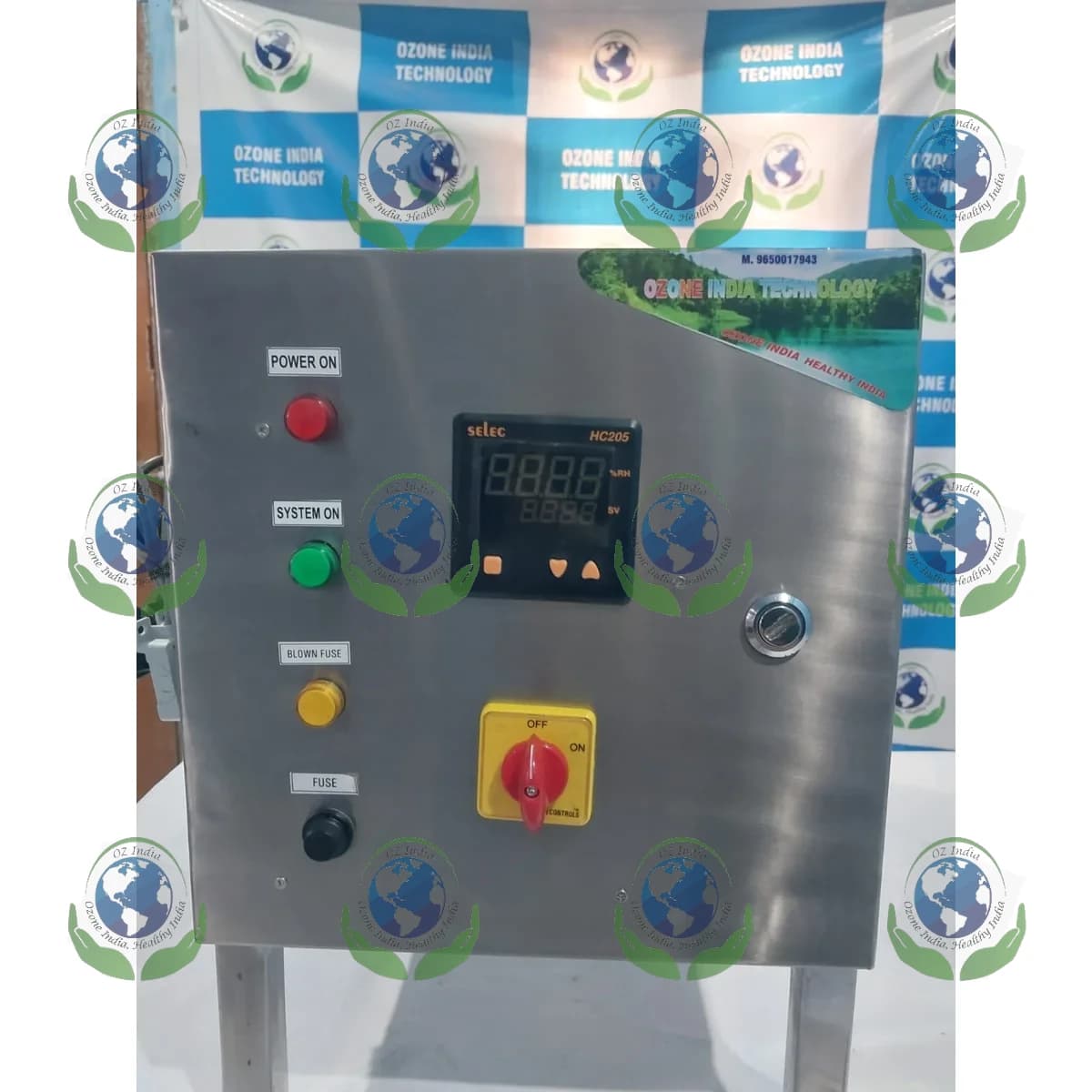
Ultrasonic Humidifier Industrial
Industrial piezoelectric ultrasonic humidifier 1-100 kg per hour for textile mills pharmaceutical and data centres
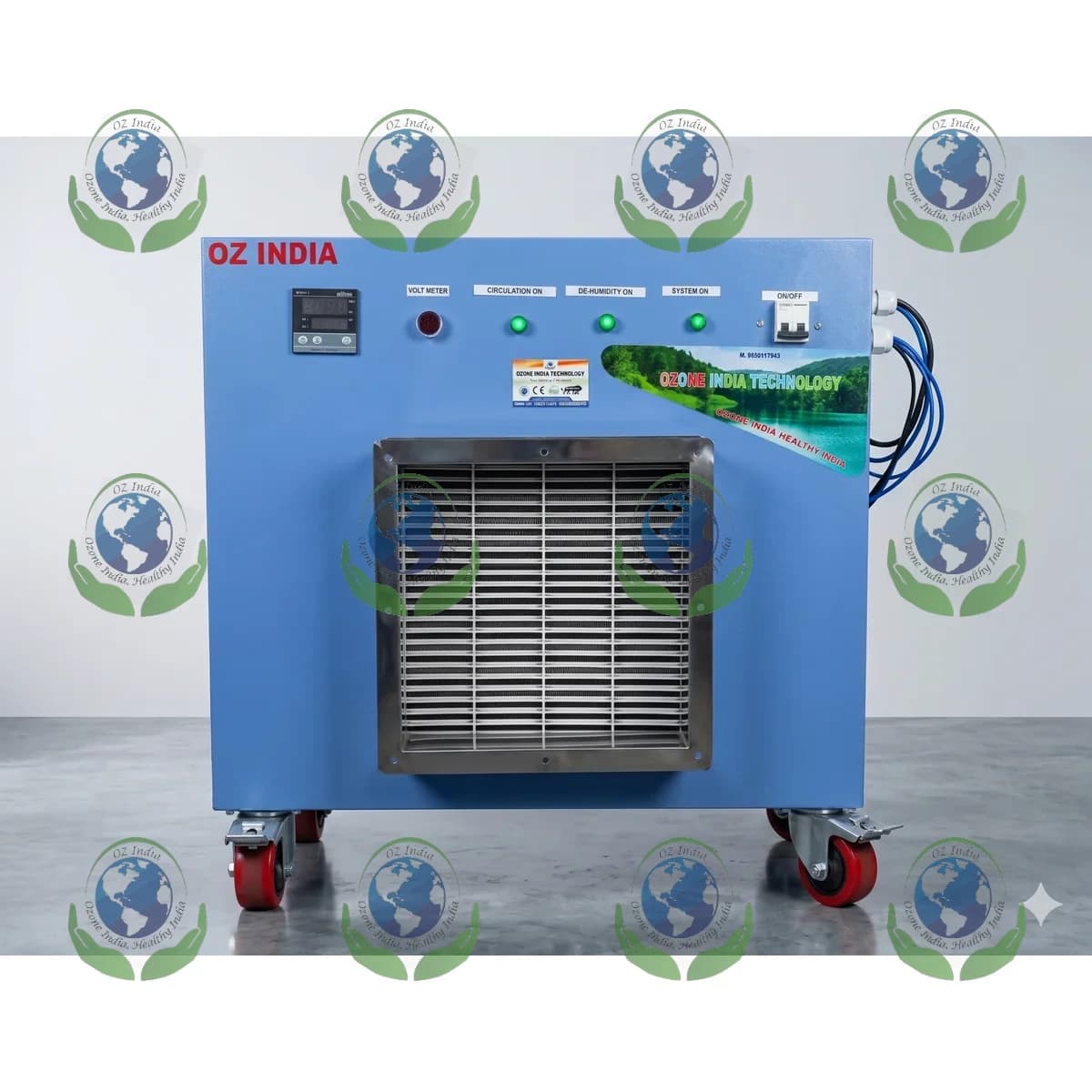
Industrial Dehumidifier
Industrial dehumidifier for pharmaceutical cold storage museum archive and humidity-sensitive process control
SIZING GUIDE
Installation & Sizing Guide
Industrial humidifier for textile mill sizing starts with the psychrometric moisture load calculation: the quantity of water (kg/hr) that must be added to the mill air to raise the relative humidity from ambient (worst-case dry season minimum) to target (IS:1060 or section-specific ATIRA recommendation). The calculation: Mass humidification load (kg/hr) = Volume air flow (m³/hr) × Air density (kg/m³) × Moisture deficit (Δω, kg water per kg dry air). The Δω is computed from psychrometric tables or the Magnus-Tetens equation: at 28°C, 65% RH target: ω_target = 0.0166 kg/kg; at 28°C, 35% RH worst-case (Ludhiana January): ω_ambient = 0.0089 kg/kg; Δω = 0.0077 kg/kg. Volume air flow for a 3,000 m² spinning section with 5 m ceiling and 20 air changes/hour = 3,000 × 5 × 20 = 300,000 m³/hr. Load = 300,000 × 1.17 × 0.0077 = 2,702 kg/hr. Apply 25% safety factor for startup transient and door infiltration: 3,378 kg/hr design capacity. Divide by unit output to determine number of units required: 3,378 ÷ 10 kg/hr per unit = 338 units — this result shows the large-scale humidification requirement of a single spinning section and illustrates why central humidification systems with distributed high-capacity units are used in large mills rather than small portable units.
Unit placement strategy for industrial humidifier for textile mill uses the evaporation distance as the primary design constraint. OZ India's 3 μm droplet evaporates completely within 2.5 metres of horizontal travel in air at 30°C/50% RH at 2 m/s air velocity. This means that all textile product, machinery, and operators must be at least 2.5 metres from the humidifier nozzle outlet — a constraint easily met by ceiling mounting at 5–7 m height with horizontal nozzle discharge, but requiring careful calculation for low-ceiling sections (below 4 m ceiling) where mounting heights are limited. For weaving sheds with 4 m ceiling height, OZ India uses angled discharge nozzles that direct mist horizontally along the loom aisles, maintaining the required 2.5 m evaporation distance before mist reaches any warp or weft thread. Humidifier unit spacing is determined by the coverage radius — one OZ India 10 kg/hr unit covers approximately 300–350 m² of spinning floor area at 5 m ceiling with 20 ACH ventilation, or 450–500 m² of weaving shed at 4 m ceiling with 10 ACH ventilation. Units are placed on a regular grid pattern within each zone, with spacing verified by post-installation RH mapping.
Seasonal operating strategy for industrial humidifier for textile mill balances humidification (required October–March in continental-climate mills) against dehumidification (required June–September in monsoon season for all Indian locations). The OZ India industrial humidifier for textile mill handles the humidification season automatically via the psychrometric controller — progressively reducing output as ambient humidity rises in spring and switching off completely when ambient moisture content exceeds the target specific humidity. During monsoon, the mill's existing ventilation system (supply air fans and exhaust fans) manages excess humidity by controlling the fresh air fraction — ATIRA recommends maintaining air changes per hour above 20 ACH in monsoon to prevent humidity rising above 80% RH in spinning sections (above 80% RH, increased moisture regain reduces fibre-to-fibre friction, causing slippage in the drafting zone and count variation). OZ India provides a seasonal operating guide with each installation — specifying the monthly target RH set-points, humidifier operating schedule, and ventilation adjustment recommendations based on local climate data for the mill's location.
CASE STUDY
Yarn Breakage Reduction and Quality Premium Recovery — Ring Spinning Mill, Ludhiana
A cotton yarn spinning mill in Ludhiana's Focal Point Industrial Area operates 14,000 ring frame spindles producing 30/40-count combed cotton yarn for domestic and export markets. Winter production (November–March) was characterised by yarn breakage rates of 18–24 ends per 1,000 spindle-hours — three to four times the ATIRA recommended target of 6–8 eph for 30-count combed cotton. RH measurement conducted by OZ India during a site survey in January showed 22–34% RH at spindle level, with the lowest readings in the north-facing bays nearest the external wall. The mill was losing approximately ₹1.2 crore per month in production value during the five-month winter period from breakage-related spindle downtime.
Additionally, the mill's export buyers in Japan (Toray Industries textile processing plant) and Germany (Textilhandel customer) were requesting humidity conditioning certificates for yarn shipments — a requirement that the mill could not meet because production atmosphere was nowhere near IS:1060 standard atmosphere conditions. One German buyer had rejected a 45-tonne shipment (valued ₹1.08 crore) on count CV% grounds — the yarn tested within specification in the mill's unconditioned QC room but outside specification when re-tested in the buyer's IS:1060-conditioned laboratory.
OZ India Technology designed an industrial humidifier for textile mill system: 21 units of 10 kg/hr (210 kg/hr total capacity), ceiling-mounted at 6 m height in the spinning section, divided into 3 humidity zones (north section, centre section, south section) each with 7 humidifier units and 4 RH sensors at spindle level. RO water pre-treatment (2,000 LPH permeate, TDS <60 mg/L) was installed in the mill's existing pump room. Psychrometric master controller with IS:1060 standard atmosphere (65% RH) as the primary set-point. Complete installation including RO system, electrical connection, and commissioning was completed in 36 hours during the annual maintenance shutdown between the Lohri and Republic Day production periods.
Post-commissioning winter monitoring (February–March of the installation year): Spindle-level RH 63–68% at all 12 sensor positions throughout production hours. Yarn breakage: 5.4 eph (72% reduction from 19.5 eph pre-installation winter average). Production recovery in the remaining 2 winter months of the first year: ₹1.86 crore (annualised ₹5.6 crore). The Japanese and German export customers each received IS:1060 conditioning certificates with the next shipments — the German buyer reinstated the previously rejected order and increased allocation to the mill by 30%. Yarn quality data: count CV% improved from 1.95% to 1.68% (13.8% improvement) — entering the premium quality grade threshold used by export buyers. The mill now commands ₹3.50/kg premium on export grade yarn, representing ₹1.26 crore/year additional revenue on 4,000 tonnes annual production (28% of production going to export at premium). Total first-year economic benefit: ₹7.1 crore (production recovery + quality premium + rejected shipment reinstatement). System investment: ₹31 lakh installed. Payback: 16 days of production.
FAQ
Frequently Asked Questions
What relative humidity is recommended for cotton spinning and weaving in India?+
ATIRA (Ahmedabad Textile Industry Research Association) recommends the following RH targets for cotton textile processing in Indian conditions: Blow room 65–70% RH; Carding 60–65% RH; Drawing and combing 60–65% RH; Ring spinning 30–40s combed: 63–68% RH; Ring spinning 60–80s combed: 65–72% RH; Open-end spinning: 60–65% RH; Warping 68–72% RH; Sizing 70–75% RH; Weaving (shuttle) 70–75% RH; Weaving (rapier/air-jet) 65–70% RH. IS:1060 Part 1 specifies 65% ±2% RH as the Indian standard testing atmosphere — meaning the production atmosphere should match testing conditions for yarn properties to be consistent between production QC and buyer QC. OZ India industrial humidifiers for textile mill are set to IS:1060 conditions (65% ±2%) as the default set-point, with section-specific adjustments per ATIRA guidance.
How does proper humidification reduce yarn breakage in ring spinning?+
Cotton fibre tensile strength increases directly with moisture regain — at 65% RH (moisture regain 8.5%), each cotton fibre is approximately 20% stronger than at 45% RH (moisture regain 5.5%) due to hydrogen bond formation between cellulose chains enhanced by adsorbed water (Kothari and Anandjiwala, ATIRA, 1975). In a yarn of 30-count, the breakage probability is determined by the weakest link in the fibre bundle — the individual fibres with lowest tensile strength and the positions with lowest inter-fibre cohesion (determined by twist and moisture). At 65% RH, the distribution of fibre strength shifts upward uniformly, reducing the frequency of below-threshold events. SITRA's 12-mill survey (2019) documented 45–72% breakage reduction when mills were humidified from 40–45% RH to 63–68% RH, with the exact reduction varying by yarn count, cotton variety, and spindle speed.
Does ultrasonic mist from OZ India humidifiers wet yarn or fabric?+
No — OZ India industrial ultrasonic humidifiers produce primary droplets of 2.5–3.5 μm diameter that are completely invisible to the naked eye and are physically incapable of settling on yarn, fabric, or machinery under normal air movement conditions. The settling velocity of a 3 μm water droplet (calculated from Stokes' law: v = d²(ρ_p − ρ_f)g/18μ) is approximately 0.026 mm/s — the droplet evaporates completely within 1–2 seconds (2–3 metres of travel at 1–2 m/s air velocity) before it can settle on any surface. This is fundamentally different from high-pressure nozzle spray systems (50–200 μm droplets) that produce visible white mist and create a wet zone extending 3–5 metres from the nozzle — wetting yarn, causing adhesion defects in sizing, and creating slip hazards on the mill floor. OZ India's humidifier nozzle placement guidelines require minimum 3 m travel distance before any textile surface, confirmed by post-installation commissioning measurement.
What are the ASHRAE 62.1 and IS:1060 humidity standards for textile mills?+
For textile mill occupational environments, two standards apply simultaneously. IS:1060 Part 1 (Indian Standard for Standard Atmosphere for Conditioning and Testing Textiles) specifies 65% ±2% RH and 27°C ±2°C — this is the production atmosphere required for textile properties measured at IS:1060 conditions to be reproducible in buyer's laboratories. ASHRAE 62.1 (Ventilation for Acceptable Indoor Air Quality) specifies acceptable indoor humidity range of 25–60% RH for occupied commercial and industrial spaces — a broader range than IS:1060's narrow textile-optimised band. Where IS:1060 requirements are more stringent than ASHRAE 62.1 (IS:1060 requires 65% RH for spinning departments, which is above the ASHRAE 62.1 upper limit for general indoor air quality), the textile production standard takes precedence because of its direct production quality impact. OZ India designs all textile mill humidification systems to IS:1060 and ATIRA standards, which are more stringent and technically appropriate than ASHRAE 62.1 for textile applications.
What water quality is needed for an OZ India industrial humidifier for textile mill?+
OZ India recommends: For mills in soft-water areas (TDS <300 mg/L, hardness <100 mg CaCO₃/L — Kerala, coastal Tamil Nadu): Municipal or borewell water can be used directly after basic filtration; inline water softener recommended to protect transducers and extend life to 10,000 hours. For mills in moderate hard-water areas (TDS 300–700 mg/L, hardness 100–250 mg CaCO₃/L — inland Tamil Nadu, Karnataka, Maharashtra): Water softener required; OZ India inline sodium zeolite softener included in system package. For mills in hard-water areas (TDS 700–2,500 mg/L — Gujarat, Rajasthan, Punjab): RO pre-treatment mandatory; OZ India compact RO system produces permeate at TDS <100 mg/L, protecting transducer life and preventing mineral dust on yarn. All water treatment systems are integrated into the humidifier package, with TDS monitoring alerting when softener or membrane requires service. Hard water used without treatment in ultrasonic humidifiers deposits calcium scale on transducers, reducing life to 1,500–2,000 hours and potentially coating yarn with fine white mineral particles.
How long does installation of an industrial humidifier for textile mill take?+
A complete OZ India industrial humidifier for textile mill installation for a 2,000 m² spinning section (10–14 humidifier units) is typically completed in 16–24 hours — one planned maintenance shift — without moving any production machinery. The installation sequence: (1) Ceiling mounting brackets fixed to existing roof structure (4–6 hours); (2) Humidifier units mounted and levelled (2–3 hours); (3) Water supply manifold and feed piping installed (3–4 hours); (4) RO or softener system installed in pump room (2–3 hours); (5) Electrical connections to distribution board (2–3 hours); (6) Controller cabinet mounted and wired (1–2 hours); (7) Commissioning and zone programming (4–6 hours, done during the first production shift). OZ India engineers manage the complete installation process and coordinate with the mill's maintenance team — the mill's own staff are not required for installation, only for access and utilities connection approval. RH mapping confirming target humidity is achieved at all production positions is documented in a commissioning report delivered within 48 hours of installation completion.
RELATED
Related Applications
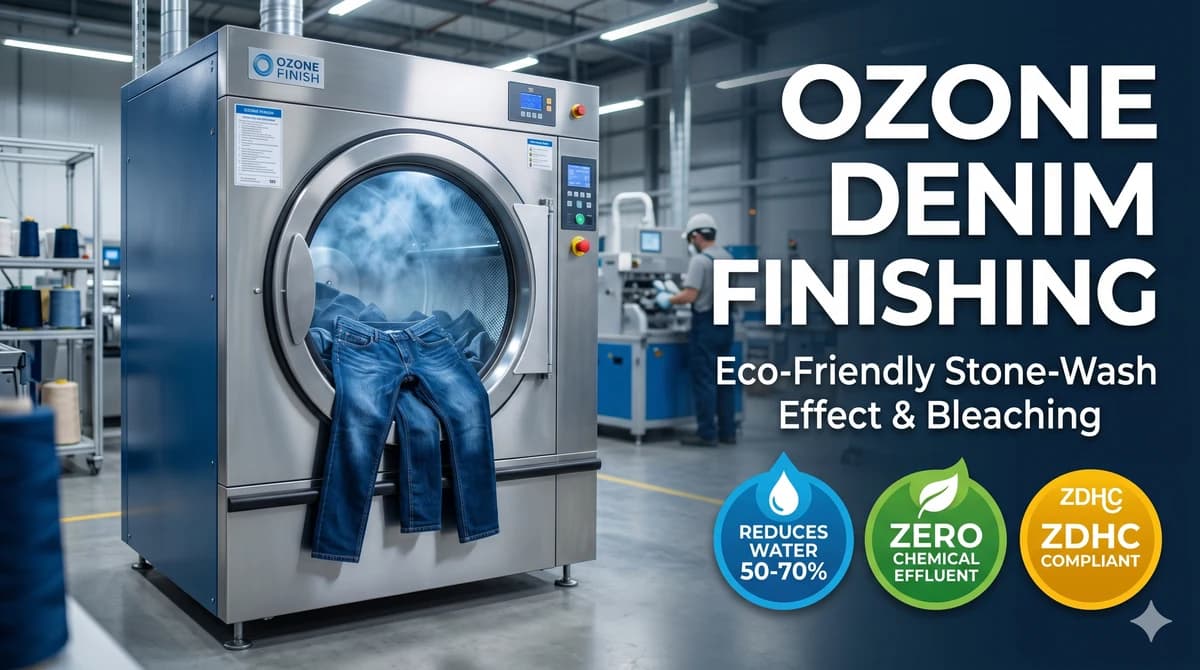
Textile and Denim Finishing
Ozone denim machine for chemical-free stone-wash effects — 70% water saving, zero pumice stone
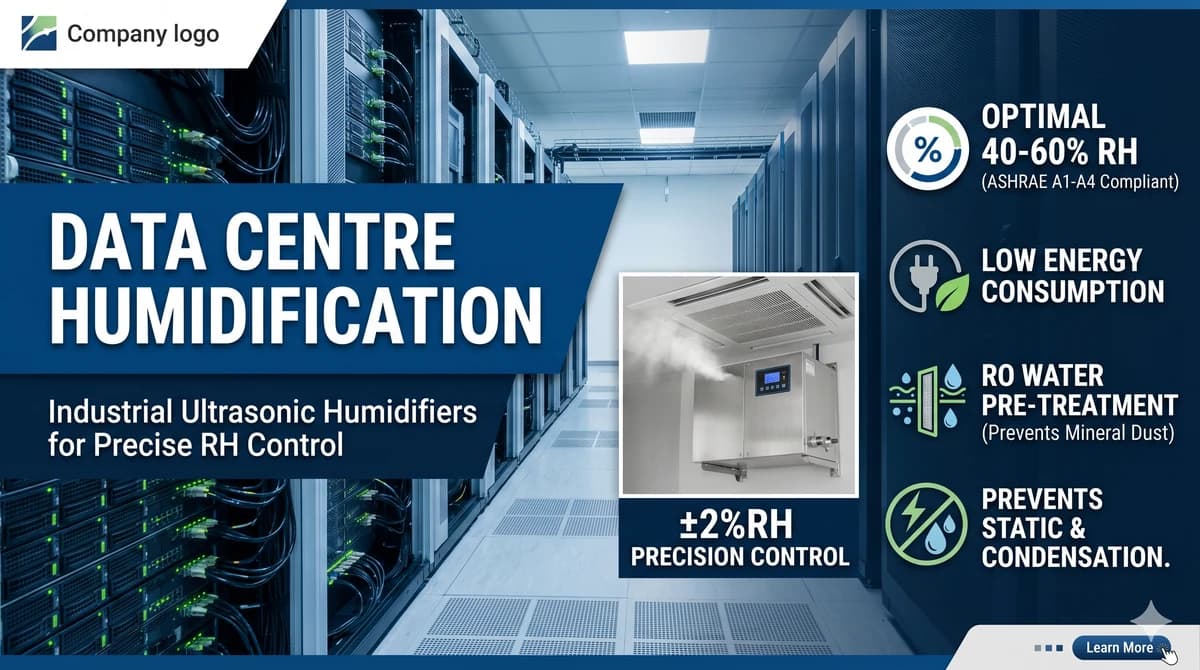
Data Centre Humidification
ASHRAE 90.4-recommended precision humidification for data centres — ESD prevention, 40–60% RH control
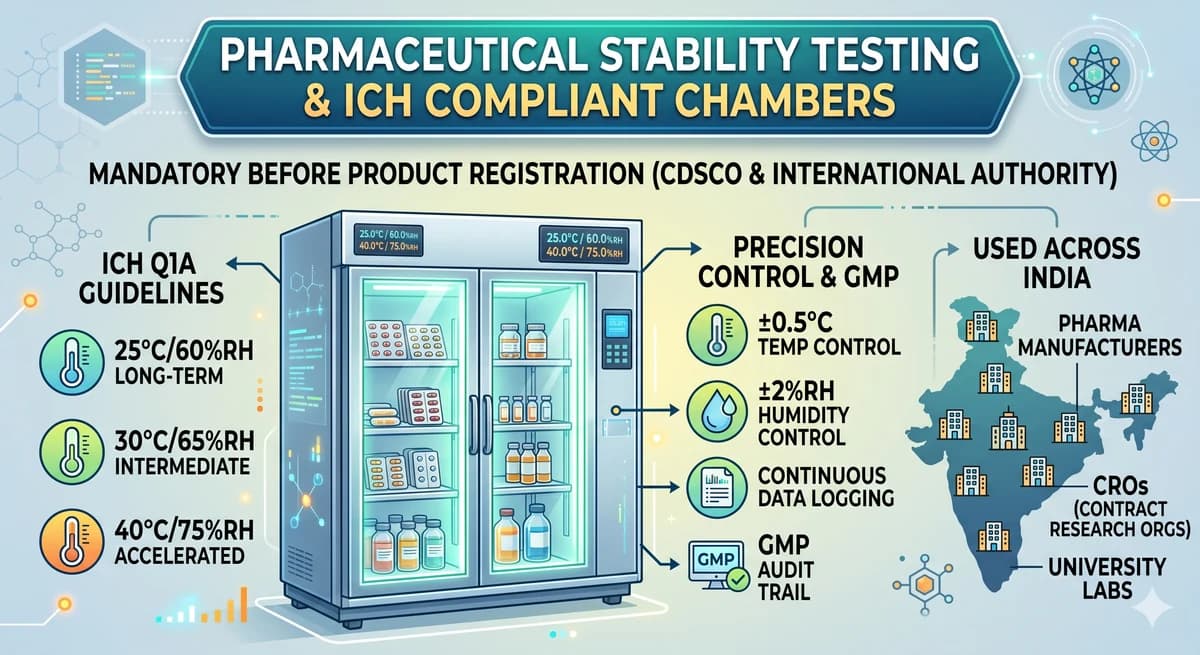
Pharmaceutical Stability Testing
ICH Q1A compliant stability chambers for Zone I–IV drug testing — CDSCO approved manufacturer
Have a question about Textile Mill?
Talk to our engineers — free technical consultation
WhatsApp Us Now