
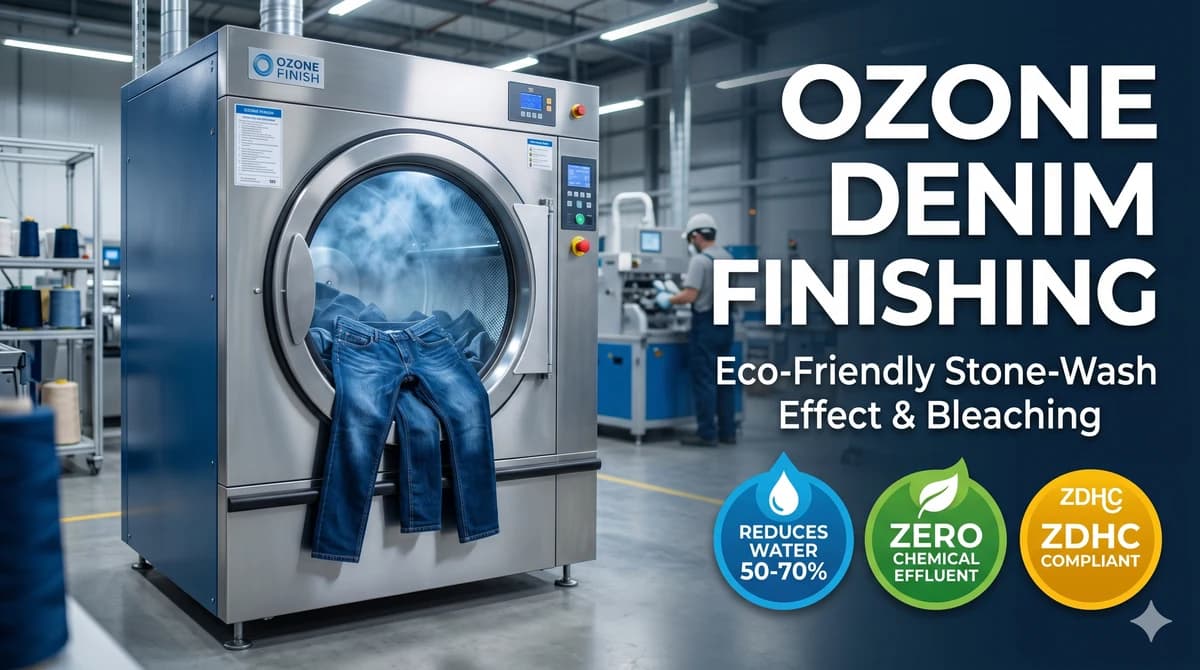
Ozone Generator in Textile and Denim Finishing
Ozone denim machine for chemical-free stone-wash effects — 70% water saving, zero pumice stone
THE NEED
Why Textile?
70%
water saving with ozone denim vs wet stone wash
60%
energy saving — no hot water or boiler needed
Zero
pumice stone required — lower fabric damage
95%
colour removal from textile ETP with ozone
GOTS
Global Organic Textile Standard — ozone compatible
30min
cycle time vs 2–3 hrs for conventional stone wash
OVERVIEW
What is Textile?
India's textile industry is the second-largest employer in the country — directly employing 45 million people in Surat's synthetic textiles, Ludhiana's knitwear, Tirupur's cotton knits, Ahmedabad's denim manufacturing, and Delhi NCR's export garment factories. It is also one of the country's most water-intensive and pollution-intensive sectors: the textile dyeing and finishing process generates 70–250 litres of wastewater per kilogram of fabric, containing reactive dyes, disperse dyes, auxiliary chemicals, and heavy metals that give textile ETP effluent its characteristic intense colour. CPCB and State Pollution Control Boards (GPCB, TN-PCB, HSPCB) have intensified enforcement against textile ETP discharge violations under NGT directions, with over 1,000 dyeing and finishing units facing closure notices for colour and COD non-compliance. Ozone treatment for textile and denim manufacturing offers a scientifically proven, regulatory-compliant solution — both for ETP colour removal and for fabric finishing processes that reduce water consumption and eliminate hazardous chemicals.
The ETP colour removal application of ozone treatment for textile and denim is grounded in extensive peer-reviewed research. Wang et al. (2016), publishing in Ozone: Science & Engineering (38(5), 374–382), demonstrated that ozone via a turbine contactor achieves >95% decolourisation of reactive dye effluent at 4–6 mg/L dose with 20 minutes contact time. Kang and Liang (1997), publishing in Chemosphere (35(10), 2153–2171), showed that ozone is superior to all conventional colour removal methods — including coagulation, activated carbon, and biological treatment — for reactive and disperse dyes. Eren and Anis (2014) in Research Journal of Chemical Sciences documented ozone's effectiveness across the full spectrum of textile chromophores: azo dyes, anthraquinone dyes, and phthalocyanine dyes — covering the entire reactive dye palette used in Surat and Tirupur dyeing units. Ozone treatment for textile and denim ETP is not a novel technology; it is the only technology capable of reliably achieving GPCB and TN-PCB colour discharge standards (ADMI below 100) from reactive dye effluent.
The denim finishing application of ozone treatment for textile and denim is arguably even more significant for the environment and the industry's sustainability credentials. Traditional stone-washing of denim — the process that gives denim its characteristic worn, faded look — uses pumice stones in rotating drums with water: consuming 40–60 litres of water per garment, generating pumice stone sludge that clogs municipal drains, causing abrasive damage to washing machines, and producing effluent containing stone fragments and fibre. Ozone treatment for textile and denim in the form of OZ India's Ozone Denim Machine replaces stone-washing with gaseous ozone exposure: denim garments in a sealed chamber are exposed to ozone gas at 5–15 ppm for 15–45 minutes, achieving the same faded, worn-wash appearance through selective oxidation of the indigo dye molecules on the denim surface. This eliminates pumice stone use entirely, reduces water consumption by 50%, reduces cycle time by 30–40%, and produces zero stone sludge.
Potassium permanganate (KMnO₄) spray is widely used in Ahmedabad and Bengaluru denim finishing to achieve local bleaching effects (scraping, whiskering) on denim garments before neutralisation with sodium metabisulphite — a two-step chemical process that introduces manganese to ETP effluent (requiring additional precipitation treatment to meet CPCB manganese discharge limit of 2 mg/L) and exposes workers to KMnO₄ inhalation risks. Ozone treatment for textile and denim replaces KMnO₄ spraying: ozone gas applied through handheld nozzles or automated spray systems bleaches denim locally through indigo oxidation, achieving identical aesthetic results without manganese waste, without chemical procurement and storage, and without worker inhalation risk. ZDHC (Zero Discharge of Hazardous Chemicals) Programme — the sustainability standard adopted by Inditex, H&M, PVH, and other global fashion buyers — specifically lists KMnO₄ as a restricted substance for denim finishing, making ozone treatment for textile and denim a prerequisite for ZDHC-compliant denim supply chains.
GOTS (Global Organic Textile Standard) certification — required by organic cotton textile exporters in Tirupur and Ahmedabad to access European and US premium organic markets — prohibits chlorine bleaching and mandates that all wastewater treatment meet GOTS ETP guidelines. Ozone treatment for textile and denim is explicitly permitted under GOTS Version 7.0 as an alternative to chlorine bleaching for both fabric and denim finishing. GOTS-certified units that install OZ India's ozone system gain a technical compliance advantage over competitors still using hypochlorite or chlorine bleaching. Similarly, the Higg FEM (Facility Environmental Module) scoring used by apparel brands to evaluate supplier sustainability rates ETP colour removal performance and chemical use — with ozone treatment for textile and denim providing measurable improvements in both ETP effluent quality (colour, COD) and chemical inventory (elimination of chlorine, potassium permanganate, and reducing agents). OZ India Technology has installed ozone treatment for textile and denim at dyeing units in Surat, Ludhiana, Bhilwara, and Tirupur — with all installations achieving SPCB compliance at commissioning.
THE SCIENCE
How Ozone & UV Work in Textile
In ETP colour removal — the most common application of ozone treatment for textile and denim — ozone is generated by the OZ India industrial ozone generator from dry air or oxygen, and injected into secondary-treated dyeing effluent using a Venturi injector or static mixer. The mechanism of colour removal is direct oxidative attack on chromophore groups — the molecular structures responsible for light absorption and colour. Reactive dyes contain azo chromophores (–N=N–) that ozone cleaves within seconds of contact, breaking the conjugated electron system responsible for colour. Anthraquinone dyes are similarly decolourised through quinone ring oxidation. At pH 9–10 (achieved by NaOH dosing before the ozone contact stage), the hydroxyl radical (•OH) pathway is enhanced — generating radicals that attack even the most recalcitrant dye molecules that resist direct ozone attack. Von Gunten (2003), in Water Research (37(7), 1443–1467), provides the kinetic framework for ozone and hydroxyl radical reactions with organic chromophores applicable to textile effluent treatment.
Contact time for ozone treatment for textile and denim ETP colour removal is 15–30 minutes at 4–6 mg/L dissolved ozone. OZ India designs baffled contact reactors that achieve plug flow conditions — preventing short-circuiting and ensuring uniform ozone exposure across the full effluent volume. For effluents with ADMI above 1000 (common from reactive dye exhaust baths), a two-stage ozone treatment with intermediate pH adjustment may be used — first stage at pH 7–8 for direct ozone attack, second stage at pH 9–10 for hydroxyl radical treatment. This two-stage approach achieves >95% ADMI reduction from highly concentrated dye effluents in a cost-efficient manner.
The Ozone Denim Machine — OZ India's product specifically engineered for ozone treatment for textile and denim finishing — operates as a sealed tumbler drum with ozone gas injection and recirculation. Denim garments (jeans, jackets, shorts) are loaded into the drum, which is sealed and purged with ozone gas from a dedicated 5–15g/hr ozone generator to achieve 5–15 ppm ozone concentration in the chamber atmosphere. Garments tumble in the ozone atmosphere for 15–45 minutes — the exact time and ozone concentration programmed by the operator to achieve the desired shade of fading. At the cycle end, the chamber is purged with fresh air through an ozone destructor before opening, ensuring worker safety. Water use is minimal — only a brief rinse is required post-ozone treatment, compared to the 40–60 litres/garment consumed in stone-washing.
For potassium permanganate replacement using ozone treatment for textile and denim, OZ India supplies a handheld ozone spray system or automated ozone spray tunnel. Ozone gas at 15–25 ppm is directed through PTFE-lined nozzles at specific areas of the denim garment (whisker patterns, seat area, thigh highlights), bleaching indigo dye locally through oxidation. The process is dry — no water, no manganese, no neutralisation step required. Workers operating handheld spray systems wear OZ India-supplied ozone-rated half-face respirators and work in well-ventilated areas with an OZ India Ozone Ambient Air Monitor alarming at 0.05 ppm. The aesthetic result of ozone treatment for textile and denim by this method is indistinguishable from KMnO₄ spray results — confirmed by leading Ahmedabad and Bengaluru denim finishing facilities that have completed the transition.
Off-gas management is essential in all ozone treatment for textile and denim applications. Textile ETP contact tanks generate off-gas containing 0.5–2% ozone (unreacted); the Ozone Denim Machine chamber purge contains 5–15 ppm ozone before treatment; KMnO₄ replacement spray systems use high-concentration ozone streams in open areas. OZ India integrates catalytic ozone destructors (MnO₂ catalyst, thermal activation at 60°C) in all fixed ozone installations, and supplies OZ India Ozone Ambient Air Monitors in all finishing room applications. Pera-Titus et al. (2004), in Applied Catalysis B: Environmental, documented the catalytic destruction kinetics of ozone relevant to off-gas treatment in textile applications — confirming that MnO₂ at 50–60°C reduces off-gas ozone below 0.02 ppm at typical contact times of 1–2 seconds. ASTM D1149 ozone resistance testing for rubber seals guides OZ India's selection of sealing materials for ozone-containing equipment in textile environments.
THE SOLUTION
Ozone India Technology Solution
OZ India Technology designs and manufactures ozone treatment for textile and denim solutions for both ETP colour removal and fabric/denim finishing applications — with installations covering the full range of Indian textile manufacturing regions. Our textile ozone ETP systems range from 5g/hr (for 100 m³/day dyeing units) to 350g/hr (for major textile cluster ETP treating 5,000 m³/day). Each system is preceded by an effluent characterisation study — ADMI, COD, BOD, reactive vs disperse dye analysis — that determines the optimum ozone dose, pH conditions, and contact time. OZ India provides an ETP performance guarantee: >90% ADMI reduction from all reactive dye effluents, documented within 30 days of commissioning.
The OZ India Ozone Denim Machine is available in three drum sizes: 50 kg/cycle (suitable for small finishing units with 500–1000 garments/day), 100 kg/cycle (mid-scale 1,000–2,000 garments/day), and 200 kg/cycle (large export units 2,000–4,000 garments/day). The machine includes the ozone generator, sealed tumbler drum, ozone circulation system, destructor, and operator control panel with programmable cycle recipes — 10 factory-set programmes covering the most common denim washing effects (light fade, mid-fade, heavy stone-wash effect, marble wash effect). Custom programmes are configured during commissioning by our textile application engineers who have trained with ozone denim machine manufacturers in Turkey and China.
OZ India's ozone treatment for textile and denim service includes buyer compliance documentation: GOTS compatibility statement, ZDHC MRSL (Manufacturing Restricted Substances List) compliance letter for ozone treatment, Higg FEM data inputs for ETP colour removal performance, and CPCB/SPCB discharge test reports from commissioned installations. These documents are required by Inditex, H&M, PVH, and other global buyers conducting factory audits under their Sustainable Sourcing programmes. Indian textile exporters to EU and US markets who install OZ India ozone treatment for textile and denim gain a verifiable, documented sustainability credential that is increasingly required — not merely preferred — by international fashion brands.
OZ India provides turnkey ozone treatment for textile and denim project delivery: site assessment (ETP layout review, denim finishing line audit), system design (P&ID, equipment schedule, electrical load list), equipment supply (CE certified, ISO 9001:2015), installation supervision, commissioning and performance testing, operator training (1 day for denim machine operators, 2 days for ETP ozone operators), and 1-year comprehensive warranty. Annual Maintenance Contracts include 4 preventive visits, emergency support, and all consumables (corona cells, sensor membranes, destructor catalyst, desiccant). OZ India's textile ozone references include units in Surat's GIDC Sachin, Ludhiana's Focal Point, and Tirupur's export garment cluster.
PERFORMANCE
Without vs With OZ India Treatment
| Parameter | Without Treatment | With OZ India System |
|---|---|---|
| ETP Effluent Colour (ADMI) | 400–1500 (SPCB non-compliant) | <100 (full SPCB compliance) |
| COD Post-Biological Treatment | 300–600 mg/L | <250 mg/L (CPCB standard) |
| Denim Wash Water Consumption | 40–60 L/garment (stone-wash) | 2–5 L/garment (ozone + rinse) |
| Pumice Stone Use | 30–50 kg/100 garments | Zero — fully eliminated |
| KMnO₄ Spray Use | Required for local bleaching | Zero — ozone spray replacement |
| ZDHC MRSL Compliance | Non-compliant (KMnO₄, Cl₂) | Fully compliant — no restricted substances |
| GOTS Certification Eligibility | Restricted — chlorine bleaching | Permitted — ozone bleaching allowed |
| Manganese in ETP Discharge | 3–8 mg/L (KMnO₄ residual) | Zero — below CPCB 2 mg/L limit |
PERFORMANCE DATA
Technical Performance Data
Reference data for ozone treatment system design and validation — applicable to Textile applications. All data per standard water treatment engineering practice (AWWA, WHO, CPCB guidelines).
Pathogen Log Inactivation at 3 mg/L Ozone (CT = 45 mg·min/L)
BOD Reduction (%) vs Ozone Dose — Typical STP/ETP Secondary Effluent
E. coli Log Inactivation vs Contact Time at 3 mg/L Ozone
System Sizing Guide — Plant Flow Rate vs Ozone Generator Capacity
RECOMMENDED EQUIPMENT
Products for Textile
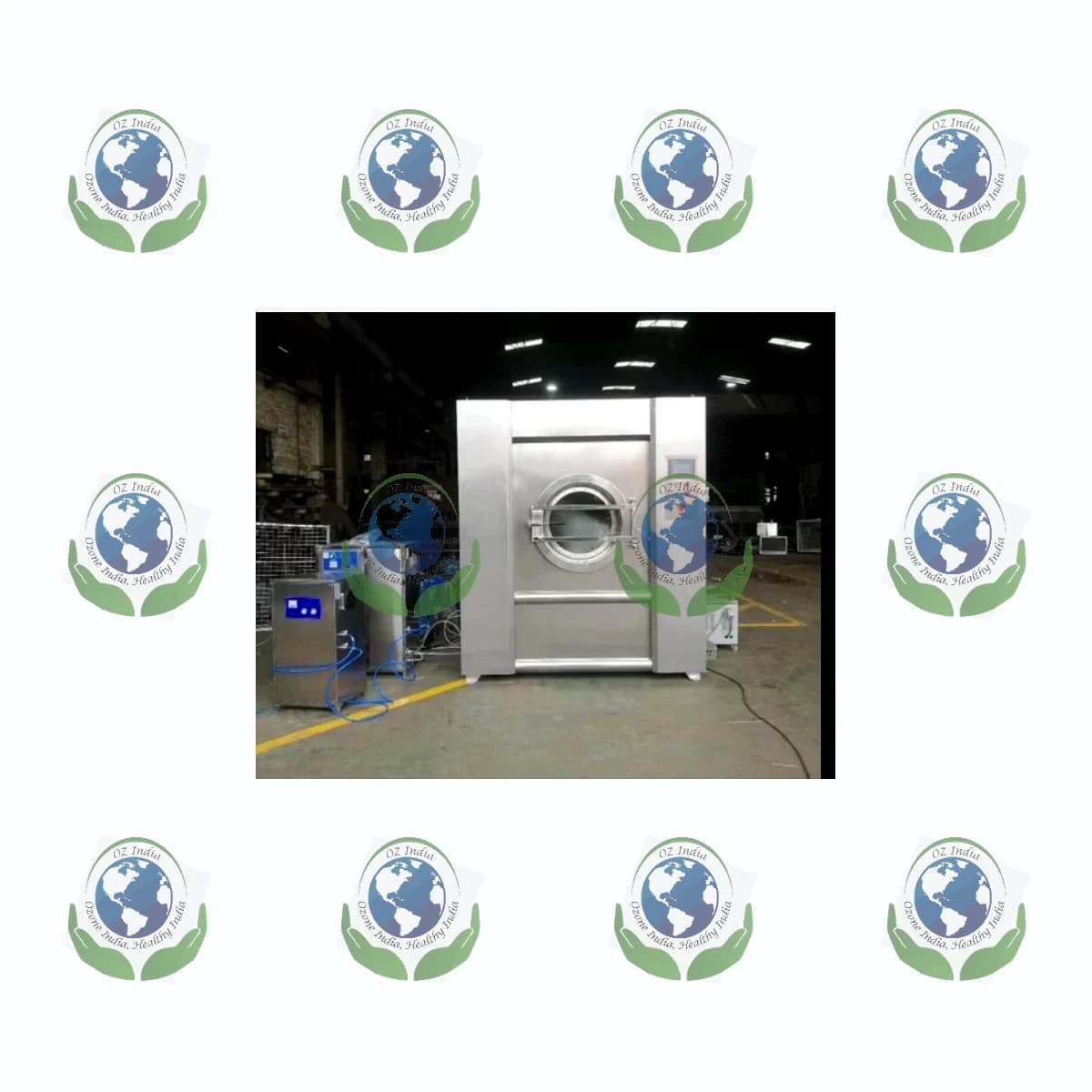
Ozone Denim Machine
Industrial ozone denim finishing machine for eco-friendly stone-wash effect without chemicals or pumice stones
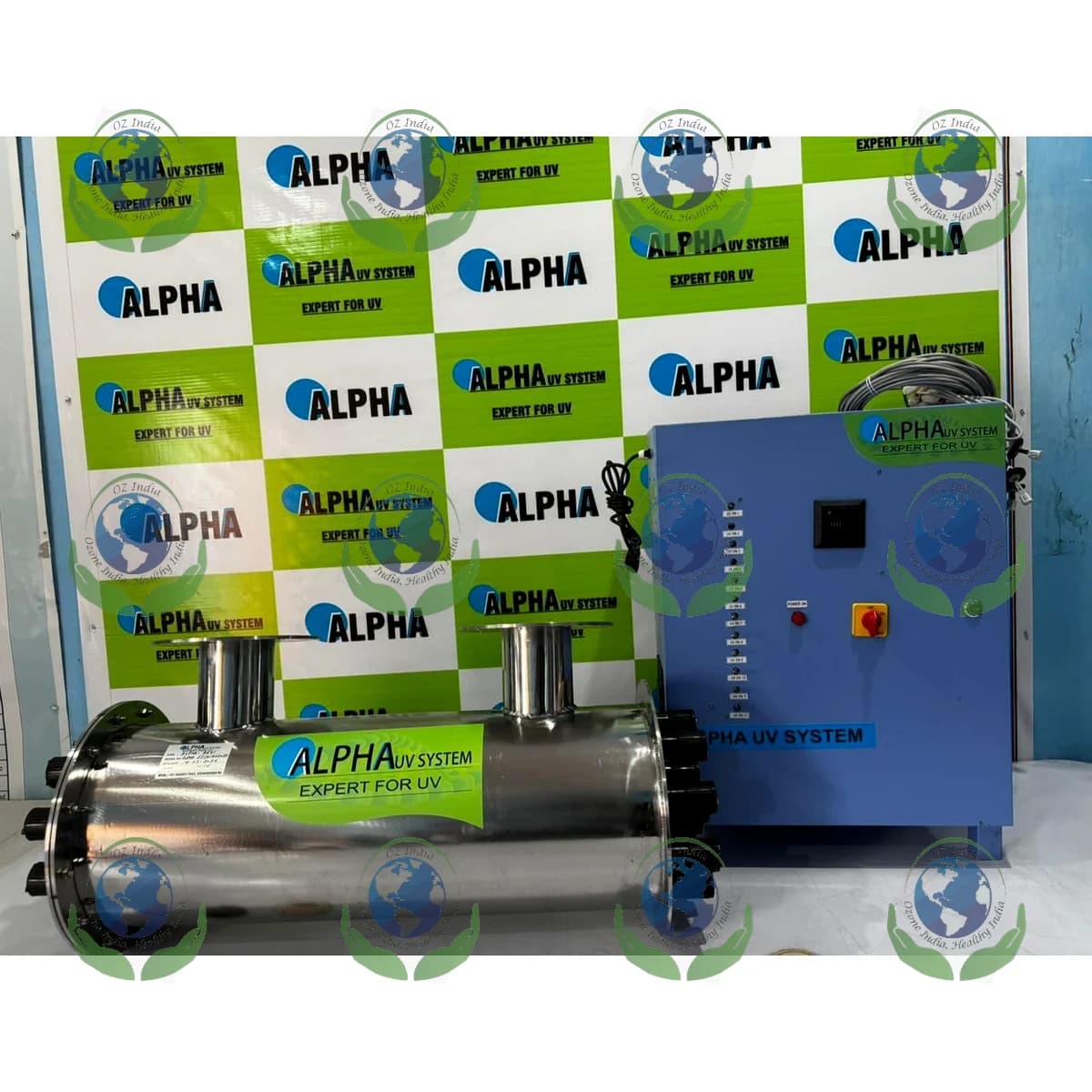
UV Wastewater Reuse Series — STP & ETP
UV disinfection for STP and ETP treated effluent reuse — CPCB tertiary discharge norms compliant
SIZING GUIDE
Installation & Sizing Guide
Sizing ozone treatment for textile and denim ETP colour removal requires: effluent flow (m³/day), ADMI colour measurement (from laboratory analysis), target ADMI (typically <100 for SPCB compliance), and effluent BOD/COD. Specific ozone dose for reactive dye colour removal: 3–5 mg O₃ per ADMI unit removed per litre. For an ADMI reduction from 800 to 80 (720 unit removal): specific dose = 720 × 3–5 = 2,160–3,600 mg/L — this is the total ozone required per litre at the contact point, which for a batch contact tank equates to a 4–6 mg/L dissolved ozone dose with 20–30 minutes contact time. Generator capacity (g/hr) = ETP flow (m³/hr) × 6 mg/L ÷ 1000 × 1000 (g/kg conversion) × 1.3 safety factor.
For an ETP of 500 m³/day (20.8 m³/hr) treating reactive dye effluent from ADMI 1000 to ADMI 80: generator capacity = 20.8 × 6 ÷ 1000 × 1000 × 1.3 = 162 g/hr — an OZ India 75–350g/hr system at mid-range output. For smaller dyeing units of 100 m³/day: generator capacity = 4.17 × 6 × 1.3 = 32.5 g/hr — a 30–50g/hr OZ India system. Contact tank volume for 20 minutes HRT: 20.8 × 20/60 = 6.9 m³ for the 500 m³/day plant. OZ India provides complete hydraulic calculation and contact tank sizing drawings — the existing ETP equalisation tank is often repurposed, avoiding new civil works.
Sizing the Ozone Denim Machine for garment finishing applications: throughput (garments/day) ÷ average weight per garment (0.5–0.8 kg/garment) = kg/day. Machine selection: 50 kg/cycle machine on a 30-minute cycle = 24 cycles/12 hours = 1,200 kg/day (1,500–2,400 garments/day). 100 kg/cycle machine: 2,400 kg/day (3,000–4,800 garments/day). Ozone generator for the denim machine: 1g/hr per 10 kg drum capacity (typical). A 200 kg machine uses a 20g/hr OZ India generator operating at 15–25 ppm chamber concentration. Machine electricity consumption: 3–5 kWh/cycle for the ozone generator plus drum motor — approximately ₹12–20 per cycle at ₹4–5/kWh industrial tariff.
Economic comparison of ozone treatment for textile and denim denim machine vs stone-washing: stone-washing costs include pumice stone (₹2–5 per garment), water (40–60 L/garment at ₹30/m³ = ₹1.20–1.80/garment), drain cleaning (₹500–1000/month for stone fragment blockages), and machine maintenance (increased wear from abrasive pumice). Ozone denim machine operating cost: electricity (₹0.25–0.40/garment), ozone corona cell (₹0.15–0.25/garment amortised), zero water, zero stone. Total saving per garment: ₹3–6. For a unit producing 2,000 garments/day: annual saving = 2,000 × 365 × ₹4.50 average = ₹32.8 lakh/year. OZ India 100 kg/cycle Ozone Denim Machine: capital cost approximately ₹18–22 lakh, payback 6–8 months from stone-washing cost savings alone.
CASE STUDY
Reactive Dye ETP Colour Removal and Denim Machine — Ahmedabad Denim Cluster
A mid-size denim manufacturing unit in Ahmedabad's Narol textile cluster was facing a dual compliance crisis: GPCB had issued an improvement notice for colour non-compliance (ETP discharge ADMI 650 vs limit 100) and the unit's primary EU buyer — an Inditex-sourcing agent — had flagged KMnO₄ spray use in denim finishing as a ZDHC MRSL violation requiring immediate corrective action. The unit was processing 1,500 garments/day of stone-washed denim using 45 tonnes of pumice stone monthly.
OZ India Technology supplied and commissioned two systems simultaneously: a 50g/hr ETP ozone system (with PSA oxygen generator, baffled contact tank, pH correction, dissolved ozone monitor) treating 350 m³/day of reactive dye effluent; and a 100 kg/cycle Ozone Denim Machine replacing all stone-washing and KMnO₄ spray operations. ETP commissioning results: ADMI 42 (93.5% reduction from 650), COD 185 mg/L (GPCB compliant) — full GPCB compliance achieved at commissioning.
The Ozone Denim Machine achieved equivalent garment fading effects to stone-washing at 30% shorter cycle time, zero pumice stone procurement (saving ₹6.75 lakh/month), and ZDHC-compliant zero KMnO₄ use. The Inditex sourcing agent's compliance audit 3 months post-installation confirmed ZDHC MRSL compliance and awarded the unit a green factory rating — opening access to new buyer programmes. Combined annual savings from ozone treatment for textile and denim (ETP compliance, stone saving, chemical saving, water reduction): ₹1.04 crore. Full payback on ozone investment: 11 months.
FAQ
Frequently Asked Questions
What percentage of colour can ozone remove from reactive dye textile ETP effluent?+
Ozone treatment for textile and denim ETP achieves 90–96% ADMI colour removal from reactive dye effluent at 4–6 mg/L dose with 20–30 minutes contact time, as demonstrated in Wang et al. (2016) and Kang & Liang (1997) and confirmed in OZ India's own installations at Surat and Tirupur dyeing units. For disperse dye effluent (common in polyester processing), ozone achieves 70–85% ADMI removal. For combined reactive and disperse dye effluent, a pilot test is recommended to determine exact dose. OZ India provides bench-scale ozone treatability tests using client effluent samples before system commissioning.
Does ozone treatment for textile and denim denim machine replace stone-washing completely?+
Yes — the OZ India Ozone Denim Machine achieves stone-wash effects through gaseous ozone oxidation of indigo dye molecules, producing identical fading and worn-look aesthetics without pumice stone, without abrasive damage to machines, and without stone fragment sludge in ETP. Water consumption reduces from 40–60 L/garment (stone-wash) to 2–5 L/garment (ozone rinse only). The machine achieves light fade, mid-fade, heavy stone-wash, and marble-wash effects through programmable ozone concentration (5–15 ppm) and exposure time (15–45 minutes).
How does ozone treatment for textile and denim replace potassium permanganate in denim finishing?+
OZ India's ozone spray system directs high-concentration ozone gas (15–25 ppm) through PTFE nozzles at specific denim areas, bleaching indigo dye locally through oxidation — identical to KMnO₄ spray effect. No manganese waste is generated, eliminating the neutralisation step and ETP manganese treatment requirement. The process is ZDHC MRSL compliant (no restricted substances), GOTS-permissible, and achieves aesthetic equivalence confirmed by buyer quality audits. Worker safety is maintained with ozone ambient air monitors and ventilation requirements per OZ India installation standard.
Is ozone treatment for textile and denim compliant with GOTS and ZDHC standards?+
Yes. GOTS Version 7.0 permits ozone as an alternative to chlorine bleaching in organic textile processing. ZDHC MRSL Version 3.1 does not restrict ozone — and specifically eliminates KMnO₄, chlorine-based bleaches, and AOX-generating chemicals that ozone replaces. OZ India provides GOTS compatibility documentation and ZDHC compliance letters for all ozone treatment for textile and denim installations, suitable for submission to buyer compliance audits conducted by Inditex, H&M, PVH, Primark, and other ZDHC signatory brands.
What COD and BOD reduction can ozone achieve in textile ETP?+
Ozone treatment for textile and denim as a standalone process achieves 30–50% COD reduction from textile effluent — insufficient alone to meet CPCB COD limits if influent COD is very high. OZ India designs ozone as the tertiary polishing stage after biological ETP treatment: biological treatment reduces BOD by 80–90% and COD by 50–60%; ozone then reduces residual colour (95%+) and polishes COD to below 250 mg/L (CPCB limit). For colour-causing COD specifically, ozone reduction reaches 70–80% because chromophoric compounds are among the most readily ozonated structures in textile effluent.
What CPCB/SPCB standards does textile ETP ozone treatment help achieve?+
Ozone treatment for textile and denim ETP enables compliance with: CPCB General Standard for discharge to inland surface water (BOD <30 mg/L, COD <250 mg/L, colour ADMI <100); GPCB site-specific standards for Surat GIDC textile units (colour <150 ADMI, BOD <30 mg/L); TN-PCB standards for Tirupur dyeing units (colour compliance); HSPCB standards for Ludhiana dyeing units. OZ India's commissioned ozone systems include guaranteed effluent quality based on influent characterisation — with performance verified during commissioning testing using NABL-accredited laboratory analysis.
How much water does ozone treatment for textile and denim save vs conventional washing?+
Ozone treatment for textile and denim denim finishing saves 50% water vs conventional stone-washing: stone-washing uses 40–60 L/garment, ozone denim machine uses 2–5 L/garment (rinse only). For a unit producing 2,000 garments/day, daily water saving = 2,000 × 40 L = 80,000 L = 80 m³. At ₹50/m³ (including ETP treatment cost), daily saving = ₹4,000; annual saving = ₹14.6 lakh in water costs alone. Reduced ETP influent volume also saves chemicals and energy in the ETP — adding a further ₹3–5 lakh/year in operational savings.
RELATED
Related Applications
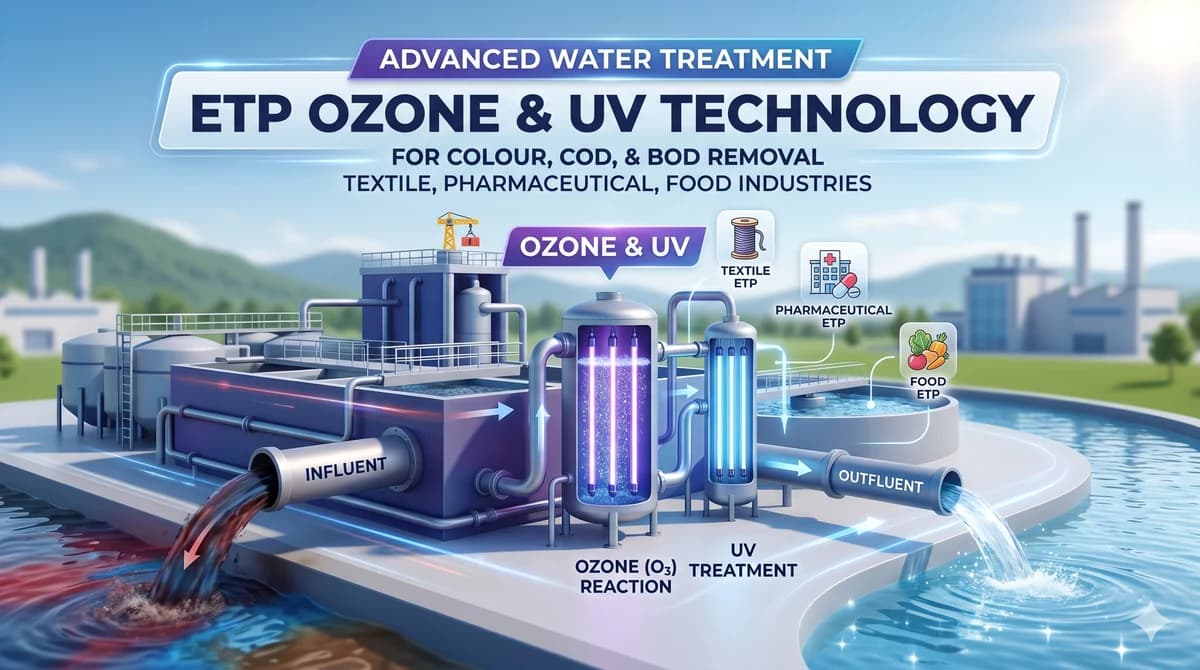
Effluent Treatment Plant (ETP)
Advanced ozone oxidation for colour removal, COD reduction, and CETP compliance in industrial ETPs
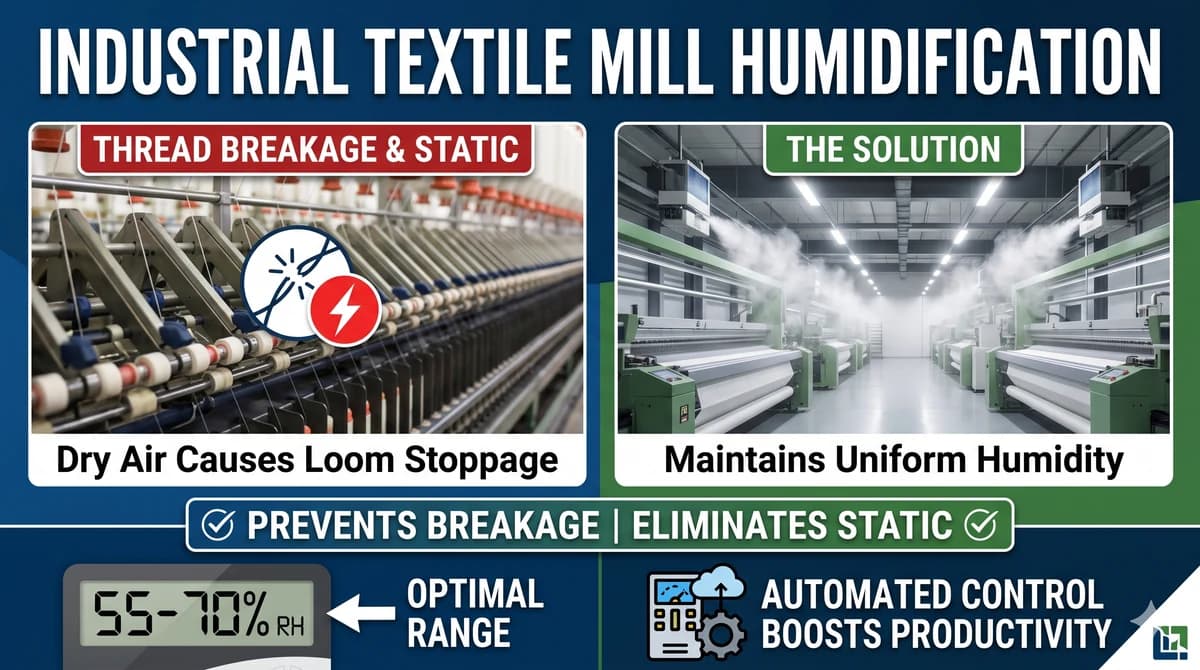
Textile Mill Humidification
Ultrasonic humidification for spinning, weaving, and finishing — 65–75% RH for zero yarn breakage

Food Processing and Safety
FSSAI-compliant ozone disinfection for food contact surfaces, CIP, cold storage, and vegetable washing