
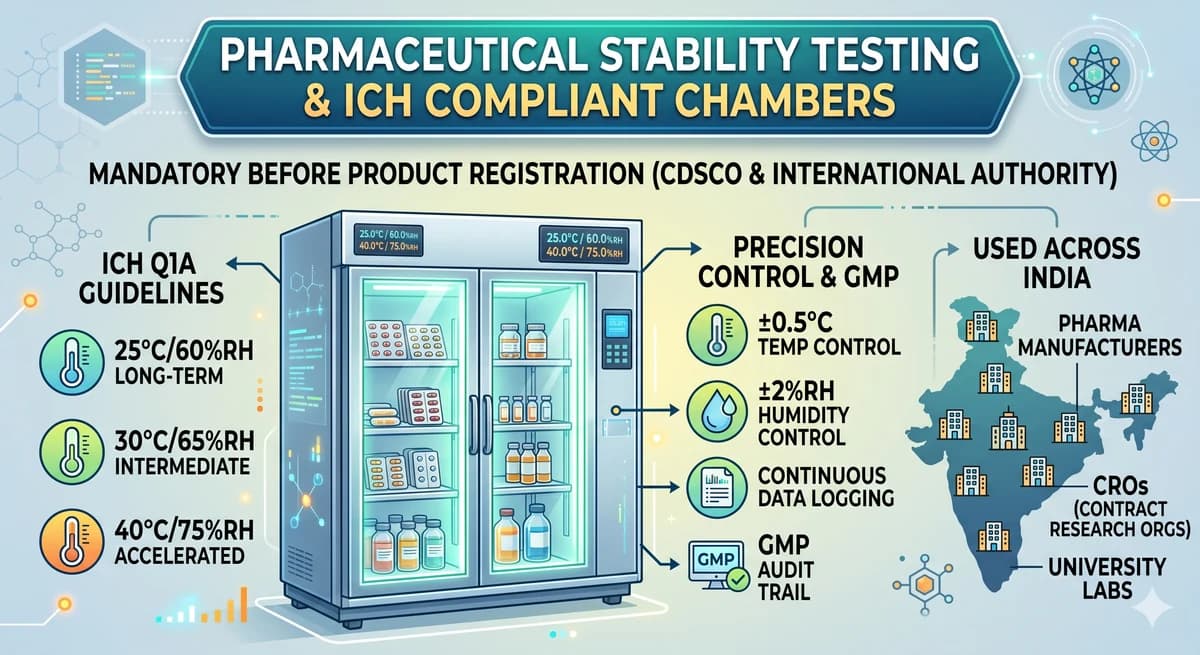
Stability Chamber for Pharmaceutical Stability Testing
ICH Q1A compliant stability chambers for Zone I–IV drug testing — CDSCO approved manufacturer
THE NEED
Why Stability Testing?
ICH Q1A
mandatory stability protocol for drug registration
Zone IV
40°C/75% RH — applicable to India and tropical countries
CDSCO
requires ICH stability data for drug approval
±0.5°C
temperature accuracy of OZ India stability chamber
±3% RH
humidity accuracy across full shelf area
21 CFR
Part 11 data logger with audit trail available
OVERVIEW
What is Stability Testing?
An ozone test chamber for pharmaceutical stability testing is a precision environmental chamber that replicates defined temperature, humidity, and ozone concentration conditions to evaluate the stability of drug substances, drug products, and pharmaceutical packaging components. The ozone test chamber for pharmaceutical stability testing serves two distinct but equally critical functions in the pharmaceutical quality system: first, it subjects drug product packaging — rubber closures, LDPE films, blister PVC, PVDC, silicone tubing, and elastomeric gaskets — to controlled ozone stress to detect material degradation before it can affect the contained drug; second, it provides the controlled ICH Q1A(R2) stability climatic conditions required to determine shelf life and expiry dating for regulatory submissions. Indian pharmaceutical plants supplying to regulated markets (USFDA, EMA, MHRA, TGA) cannot obtain drug approval without ICH-compliant stability data, making the ozone test chamber for pharmaceutical stability testing a mandatory capital investment in every formulation facility.
ICH Q1A(R2) — the international harmonised guideline for stability testing of new drug substances and products, adopted by CDSCO for new drug approvals in India — mandates a structured stability programme across multiple climatic conditions. The standard conditions are: long-term testing at 25°C/60% RH (Zone II, EU/USA) for 12–60 months; intermediate testing at 30°C/65% RH (Zone III/IVa) for 12 months; accelerated testing at 40°C/75% RH for 6 months. India's climatic classification as WHO Zone IVb (hot and very humid: mean kinetic temperature 30°C, mean annual RH 70%) means CDSCO requires long-term stability data at 30°C/75% RH for products registered in India — a condition that must be continuously maintained in the stability chamber for the product's entire intended shelf life. The ozone test chamber for pharmaceutical stability testing must hold these conditions to ±0.5°C and ±5% RH throughout the study duration, with continuous data logging and alarm management.
Rubber and elastomeric packaging components are among the most ozone-sensitive materials in pharmaceutical manufacturing, yet they are in direct contact with injectable drugs, ophthalmic preparations, and inhalation products. Rubber closures for vials (bromobutyl, chlorobutyl, natural rubber), plungers for pre-filled syringes, seals for cartridges, and silicone tubing for IV sets are all susceptible to ozone degradation — a process that begins with ozone attacking carbon-carbon double bonds in the rubber polymer chain (ozonolysis), leading to surface cracking, loss of elasticity, and ultimately, leachable chemical contamination of the drug product. ASTM D1149 and ISO 1431-1 — the standards for rubber ozone cracking resistance testing — specify the use of an ozone test chamber for pharmaceutical stability testing at 40–50 pphm ozone concentration with 20% tensile strain applied to the rubber specimen, providing a time-compressed assessment of material performance over the intended service life.
The ozone test chamber for pharmaceutical stability testing from OZ India is designed to meet the dual requirements of ICH Q1A(R2) climatic stability testing and ASTM D1149/ISO 1431-1 rubber ozone cracking testing within a single, programmable chamber platform. This dual functionality eliminates the cost of maintaining two separate chamber types — one for drug product stability and one for packaging material qualification — while ensuring all testing is conducted under documented, calibrated, and GMP-compliant conditions. The chamber's programmable controller stores up to 50 test protocols covering all ICH stability zones, rubber ozone testing at multiple concentration levels, and custom protocols for packaging validation studies. Data logging at 15-minute intervals with NIST-traceable calibration certificates supports CDSCO new drug application submissions and USFDA IND/NDA/ANDA dossiers.
India's pharmaceutical packaging validation landscape is evolving rapidly. The 2023 CDSCO Schedule M amendment specifically references ICH Q1A(R2) stability protocol compliance and mandates that stability chambers be qualified (IQ/OQ/PQ), periodically calibrated, and operated with documented environmental monitoring. WHO TRS 1010 Annex 7 (2018), which CDSCO has incorporated by reference into new drug approval guidelines, requires that stability storage conditions be validated against the specified ICH climatic zone and documented with continuous temperature/humidity records with no unresolved excursions. For rubber and polymer packaging qualification, the ozone test chamber for pharmaceutical stability testing must demonstrate ozone concentration accuracy of ±5 pphm at the test specimen location — a specification that requires an integrated ozone generator, precision ozone analyser, and chamber airflow engineering that only purpose-built pharmaceutical stability chambers from manufacturers like OZ India can deliver.
THE SCIENCE
How Ozone & UV Work in Stability Testing
The ozone test chamber for pharmaceutical stability testing integrates three controlled environment systems within a single insulated enclosure: a refrigeration-heating system for temperature control, an ultrasonic humidification-dehumidification system for relative humidity control, and an internal ozone generation and monitoring system for ozone concentration control. Temperature is regulated by a cascade PID controller — the primary controller monitors chamber air temperature, the secondary controller drives the refrigeration compressor or heating elements — achieving ±0.5°C uniformity throughout the usable chamber volume. The temperature uniformity mapping test (per ASTM E145 and DIN 40046) measures temperature at 9 points in the chamber cross-section simultaneously, with the mapping report forming part of the chamber OQ documentation.
Relative humidity in the ozone test chamber for pharmaceutical stability testing is controlled by a microprocessor-driven ultrasonic nebuliser (humidification) and a Peltier-effect dehumidifier (dehumidification). The ultrasonic nebuliser generates water vapour droplets at 2–4 µm diameter that evaporate completely before reaching the product, avoiding condensation on drug product samples — a critical feature for ICH accelerated testing at 40°C/75% RH where condensation could invalidate samples. The Peltier dehumidifier operates without refrigerants (CFC-free design) and removes excess humidity during transitions from high-humidity to low-humidity test protocols. Combined, these systems achieve ±5% RH control throughout the ICH-specified range of 40–90% RH.
Ozone generation within the ozone test chamber for pharmaceutical stability testing uses a compact corona discharge cell mounted in the chamber's air circulation plenum, ensuring ozone is thoroughly mixed into the circulating airstream before reaching test specimens. The ozone concentration is maintained at the test protocol setpoint (typically 50 pphm for ASTM D1149 rubber testing, or 25–100 pphm for custom polymer degradation studies) by a feedback control loop from the chamber's in-built UV photometric ozone analyser — the most accurate and stable measurement technology for chamber applications. The UV photometric analyser measures ozone concentration at the chamber exhaust point every 30 seconds, with the PID controller adjusting the corona discharge cell power to maintain the setpoint within ±2 pphm.
For ICH Q1A(R2) pharmaceutical stability studies, the ozone generation system is typically disabled (or maintained at ambient background, <0.01 pphm) as ICH conditions do not specify ozone exposure. The chamber functions purely as a precision climatic chamber in these applications, maintaining 40°C/75% RH (accelerated), 30°C/65% RH (intermediate), or 30°C/75% RH (Zone IVb) conditions with continuous data logging. The chamber controller logs temperature and humidity every 15 minutes to internal memory (30-day rolling buffer, 12-month archival to SD card), and triggers alarms at ±1°C and ±5% RH from setpoint, with automatic fault recovery protocols that restart the temperature/humidity control system after power restoration — ensuring no data gaps that could invalidate a stability study.
Chamber uniformity in the ozone test chamber for pharmaceutical stability testing is ensured by a forced-air recirculation fan system that creates a consistent laminar airflow pattern across all shelf positions. The OZ India stability chamber is validated for loading density of up to 70% of usable volume (per ASTM E145 guidelines), with temperature uniformity maintained to ±1°C at maximum load — a critical design constraint since pharmaceutical stability studies often require continuous loading of 200–500 sample units across multiple shelf levels. Chamber access during a running study is managed through a programmable door opening sequence that minimises temperature/humidity recovery time — OZ India chambers recover to setpoint within 3 minutes of a normal door opening, minimising study interruption for sampling events.
THE SOLUTION
Ozone India Technology Solution
OZ India Technology manufactures the ozone test chamber for pharmaceutical stability testing in capacities from 100 litres to 1,000 litres (walk-in), covering individual packaging validation studies to full-scale ICH multi-year stability programmes. Our chambers carry CE marking (CE-2621A), ISO 9001:2015 quality certification (UQ-270426AD1), and are designed to ICH Q1A(R2) climatic requirements with NIST-traceable temperature and humidity calibration. Each chamber is supplied with a complete IQ/OQ documentation package: design drawings, material certificates, calibration certificates, uniformity mapping data, and 21 CFR Part 11 compliant data logger configuration — reducing the validation burden on your QA team by 4–6 weeks compared to assembling chambers from non-documentation-ready vendors.
OZ India's pharmaceutical stability chamber range includes three configurations: the ST-100 (100L, benchtop), ST-250 (250L, floor-standing), and ST-500 (500L, floor-standing), all with dual-function ICH stability and ASTM D1149 ozone testing capability. The walk-in stability room (1,000–5,000L) is custom-engineered for pharmaceutical plants with large stability inventories — maintaining ICH Zone IVb conditions (30°C/75% RH) across the full room volume with independent zonal temperature/humidity monitoring at six points. For rubber component qualification per ASTM D1149/ISO 1431-1, the OZ India chamber includes an integrated specimen holder frame with 20% strain jig, ensuring standardised specimen orientation for reproducible ozone cracking test results.
Calibration and maintenance of the ozone test chamber for pharmaceutical stability testing is managed through OZ India's pharma-sector AMC (Annual Maintenance Contract) programme, designed specifically for GMP-regulated environments. The AMC includes quarterly temperature/humidity calibration against NIST-traceable standards with formal calibration certificate issue, annual ozone analyser span gas calibration, chamber interior HEPA filter replacement, and refrigerant system check. All calibration activities are conducted under a documented calibration protocol with full traceability records — directly suitable for inclusion in your equipment qualification master plan. Emergency service response within 24 hours anywhere in India ensures that critical stability studies are not compromised by equipment downtime.
OZ India's installation base for the ozone test chamber for pharmaceutical stability testing spans India's major pharmaceutical manufacturing clusters: Baddi and Nalagarh (Himachal Pradesh), Hyderabad Genome Valley and Medak (Telangana), Ankleshwar and Vapi (Gujarat), Aurangabad and Nashik (Maharashtra), and Haridwar and Dehradun (Uttarakhand). Our application engineers understand the specific stability requirements of different dosage forms — sterile injectables (USP <660> container testing), ophthalmic preparations (Ph.Eur. 3.2.9 rubber closure compatibility), oral solid dosage (ICH accelerated 40°C/75%RH blister integrity), and biologics (cold-chain stability at 2–8°C and −20°C) — enabling accurate chamber specification and protocol design from your first enquiry.
PERFORMANCE
Without vs With OZ India Treatment
| Parameter | Without Treatment | With OZ India System |
|---|---|---|
| ICH Q1A(R2) climatic conditions supported | Standard climatic chamber (temp only) | 40°C/75%RH, 30°C/75%RH, 30°C/65%RH, 25°C/60%RH |
| Ozone testing per ASTM D1149/ISO 1431-1 | Not possible (separate equipment needed) | Built-in, 0–100 pphm, ±2 pphm accuracy |
| Temperature uniformity | ±2–3°C (unstandardised chambers) | ±0.5°C (ASTM E145 validated) |
| Data integrity for FDA 21 CFR Part 11 | Paper logs, manual records | Automated, audit-trail, electronic records |
| Calibration traceability | Uncertified or incomplete | NIST-traceable, ILAC G8 compliant |
| IQ/OQ documentation package | Not provided | Complete DQ/IQ/OQ package supplied |
| CDSCO Schedule M compliance | Requires extensive plant QA effort | Documentation-ready, inspection-ready |
| Dual ICH + rubber ozone testing | Two separate chambers required | Single chamber, programmable protocols |
PERFORMANCE DATA
Technical Performance Data
Reference data for ozone treatment system design and validation — applicable to Stability Testing applications. All data per standard water treatment engineering practice (AWWA, WHO, CPCB guidelines).
Pathogen Log Inactivation at 3 mg/L Ozone (CT = 45 mg·min/L)
BOD Reduction (%) vs Ozone Dose — Typical STP/ETP Secondary Effluent
E. coli Log Inactivation vs Contact Time at 3 mg/L Ozone
System Sizing Guide — Plant Flow Rate vs Ozone Generator Capacity
RECOMMENDED EQUIPMENT
Products for Stability Testing
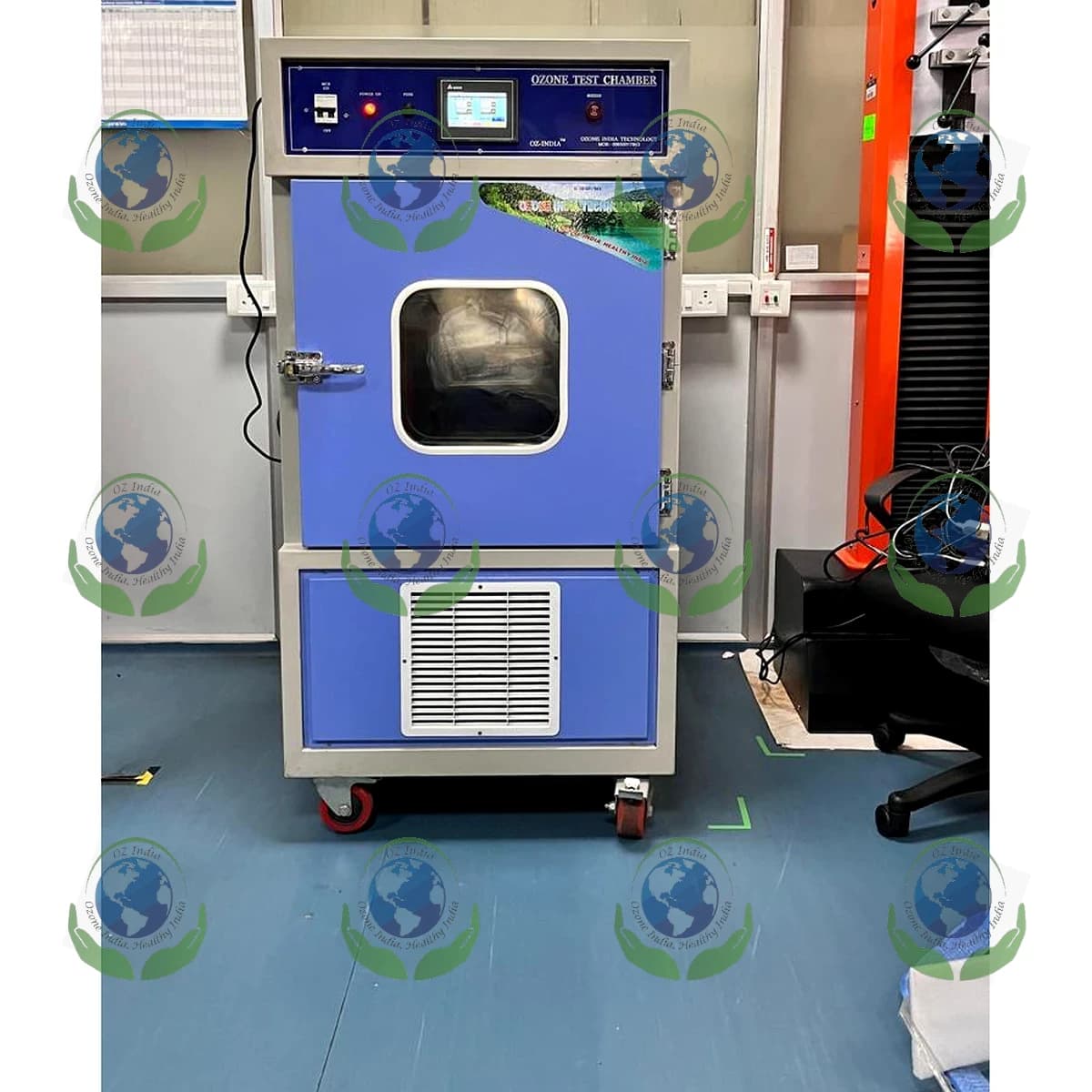
Stability Chamber ICH Q1A
ICH Q1A pharmaceutical stability chamber 25C 60RH and 40C 75RH for drug stability studies and shelf-life testing
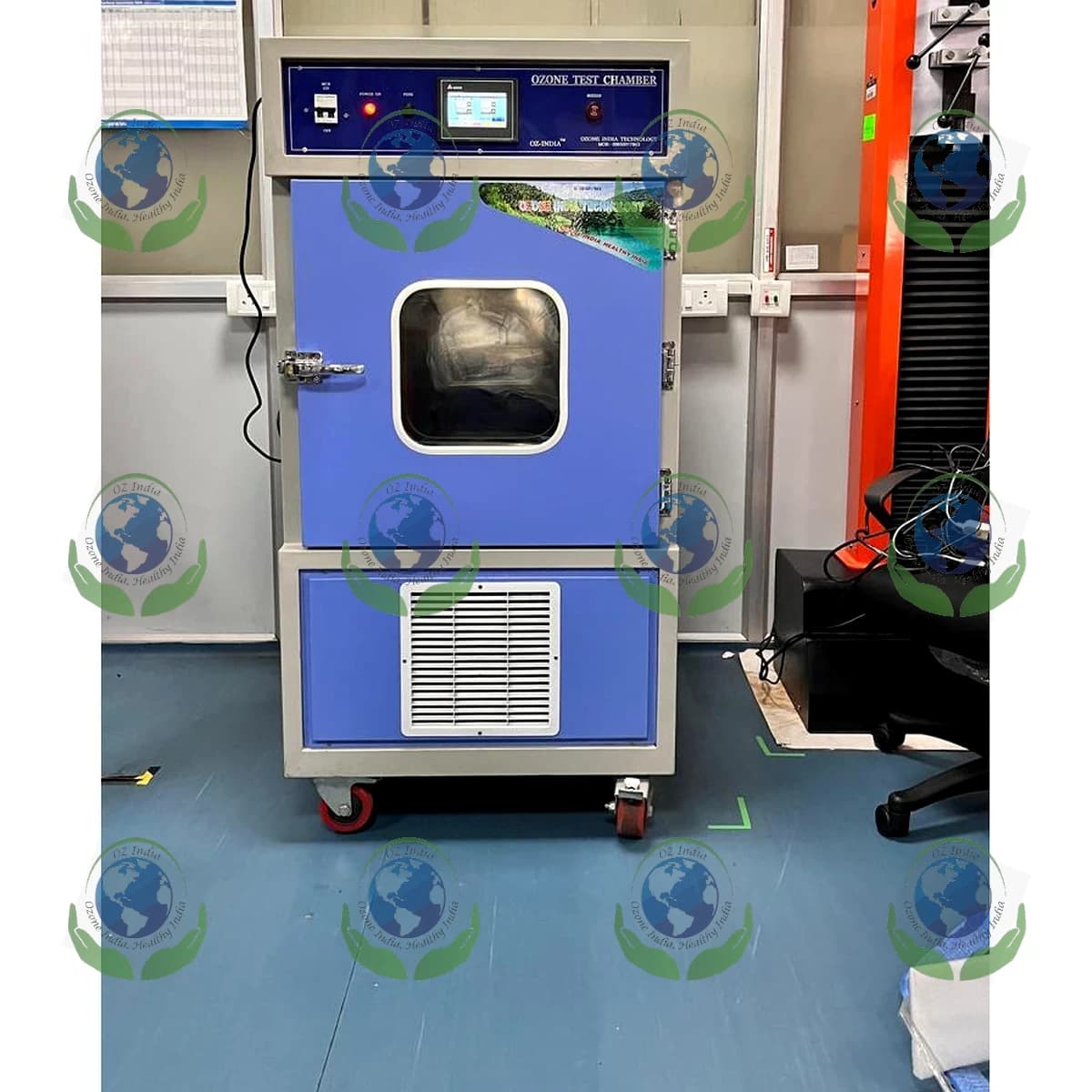
Humidity Chamber
Precision humidity test chamber 20-98 percent RH for textile fibre material and component moisture testing IS 1060
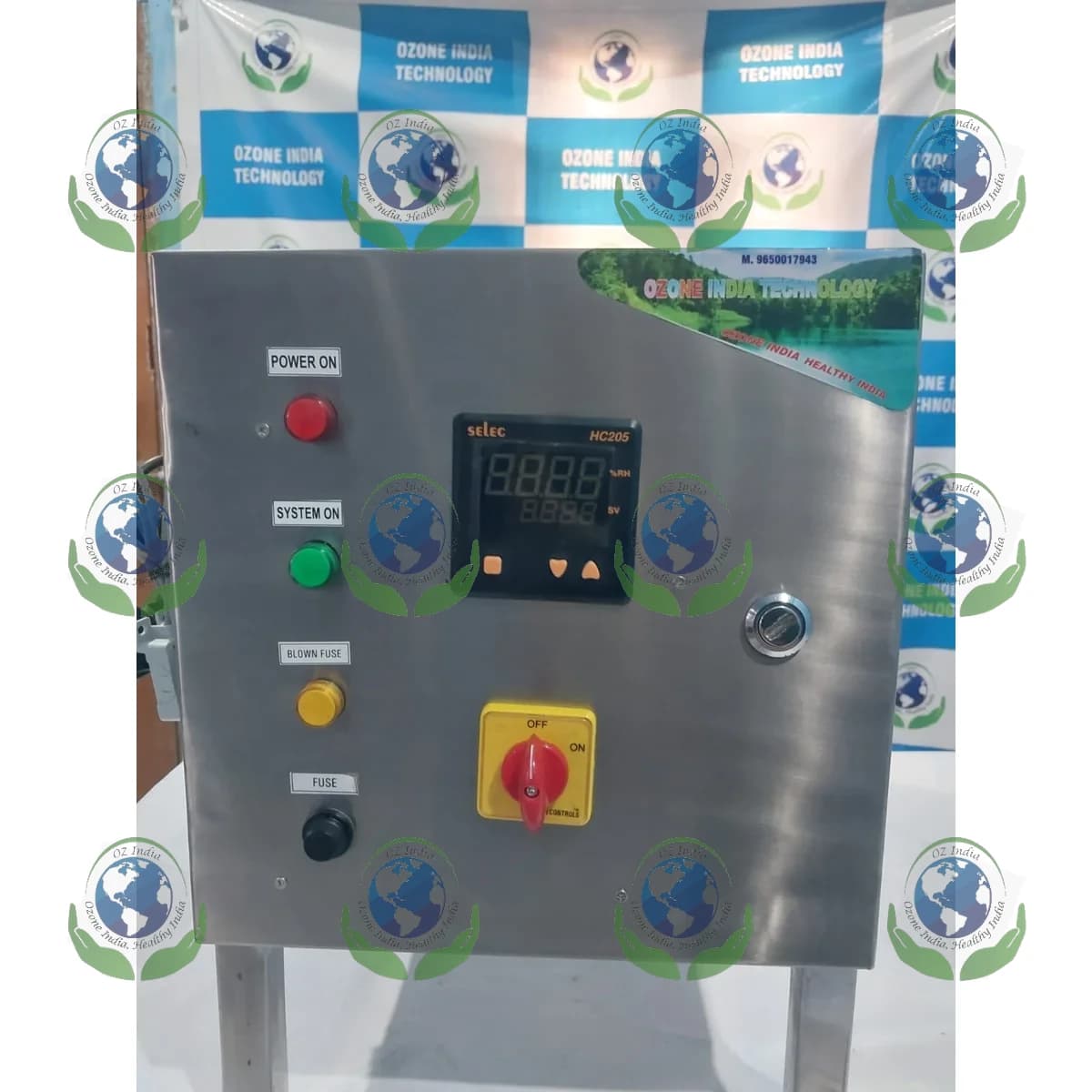
Ultrasonic Humidifier Industrial
Industrial piezoelectric ultrasonic humidifier 1-100 kg per hour for textile mills pharmaceutical and data centres
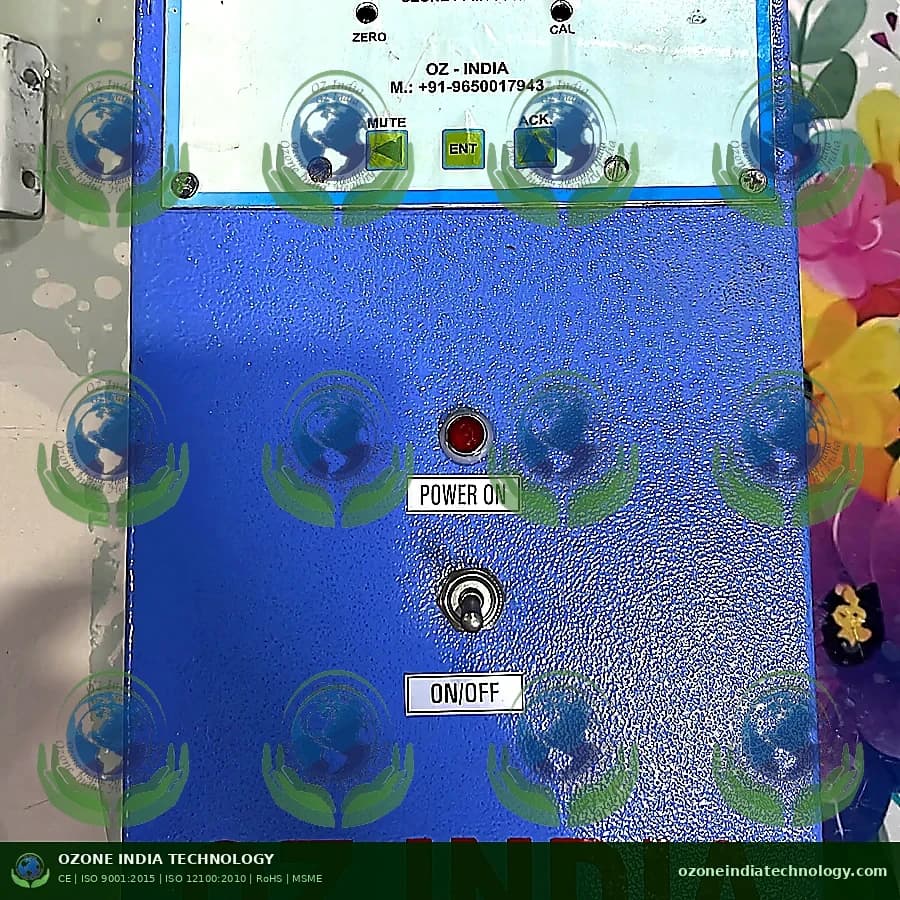
Ozone Ambient Air Monitor
Real-time ozone air monitoring with Delta PLC, HMI touchscreen & USB data logging
SIZING GUIDE
Installation & Sizing Guide
Sizing an ozone test chamber for pharmaceutical stability testing correctly is the first step to a compliant ICH stability programme. Begin by calculating the total stability inventory: number of batches per product × number of time points × number of replicates × sample volume. The ozone test chamber for pharmaceutical stability testing capacity you select must accommodate peak inventory without compromising airflow uniformity. ICH Q1A(R2) requires minimum three primary batches for new drug substances, with samples pulled at 0, 3, 6, 9, 12, 18, 24, 36, 48, and 60 months for long-term studies — totalling 30 primary samples per batch per condition. For a plant with 20 active stability studies across three ICH conditions, minimum required chamber space is typically 250–500 litres per condition. OZ India provides a stability inventory calculator — input product count, batch frequency, and sample dimensions to receive a recommended chamber capacity.
For rubber and polymer component qualification using the ozone test chamber for pharmaceutical stability testing per ASTM D1149, chamber sizing is based on specimen quantity and the required 20% strain jig frame dimensions. A standard ASTM D1149 test requires 3–6 dumbbell specimens per material grade per test condition, with each specimen approximately 25 mm × 6 mm cross-section. OZ India's standard ST-250 chamber accommodates two full strain jig frames — sufficient for testing 12–18 specimens simultaneously per test condition. For plants with multiple rubber material grades requiring simultaneous qualification (e.g., bromobutyl, chlorobutyl, and natural rubber closures for the same product), the ST-500 provides four jig frame positions.
Temperature and humidity setpoint combinations determine chamber specification: stability studies requiring simultaneous ICH 40°C/75% RH and 30°C/65% RH conditions require two separate chambers — it is not possible to maintain two temperature setpoints in a single chamber simultaneously. OZ India recommends a minimum of two chambers for any pharmaceutical plant with active CDSCO or USFDA new drug dossiers: one configured for 40°C/75% RH (accelerated), one for 30°C/75% RH (Zone IVb long-term). A third chamber at 5°C ± 3°C handles cold-chain product stability. OZ India's modular chamber design allows future capacity expansion by stacking additional chambers with shared data logging infrastructure — avoiding the need for a single large chamber that becomes a single point of failure.
Power consumption and facility requirements for the ozone test chamber for pharmaceutical stability testing: the OZ India ST-250 (250L) requires a single-phase 230V, 15A dedicated circuit; the ST-500 (500L) requires three-phase 415V, 16A; walk-in rooms require dedicated electrical sub-panel design. Each chamber produces 500–1,500 W of heat dissipation to the room — facility air conditioning must be sized to handle this load for all chambers operating simultaneously. UPS power backup is strongly recommended for ICH stability chambers: a grid power failure of >30 minutes with temperature excursion may invalidate the entire stability study, requiring costly sample restocking and restart. OZ India provides UPS integration as an option with all pharmaceutical stability chambers, along with automatic transfer switch (ATS) for generator backup.
CASE STUDY
Packaging Validation for Export Injectable at Hyderabad Formulation Plant
A major injectable formulation plant in Hyderabad's Genome Valley — supplying lyophilised sterile products to USFDA and EMA regulated markets — was preparing a packaging change from natural rubber closures to bromobutyl rubber closures for its vial-filled products. EMA ICH Q1A(R2) requirements and the company's internal packaging validation SOP mandated ozone cracking resistance testing per ASTM D1149 and ISO 1431-1 as part of the closure qualification protocol. The plant's existing stability chambers were ICH-configured only, with no ozone generation capability — creating a gap in the packaging qualification programme.
OZ India Technology supplied an ST-250 ozone test chamber for pharmaceutical stability testing — dual-function ICH stability and ASTM D1149 ozone testing — with integrated UV photometric ozone analyser, strain jig frames for 12 specimens, and a 21 CFR Part 11 compliant data logger. The chamber was validated (IQ/OQ) over 10 working days, with uniformity mapping at both ICH conditions and ozone cracking test conditions (40°C, 50 pphm ozone, 20% strain). ASTM D1149 testing on bromobutyl and natural rubber closure specimens was completed in 96 hours, with the bromobutyl specimens showing no surface cracking at 40 pphm/96 hr, confirming superior ozone resistance and supporting the packaging change notification to USFDA.
Post-qualification, the ozone test chamber for pharmaceutical stability testing was reconfigured for continuous ICH 40°C/75% RH accelerated stability operation, holding 18 active drug product stability studies for the plant's ANDA pipeline. The 21 CFR Part 11 data log, with zero unresolved temperature or humidity excursions in the first 12 months of operation, was directly included in two ANDA submissions to USFDA. The USFDA review division accepted the stability data without a chemistry, manufacturing, and controls (CMC) information request — a significant reduction in the ANDA review timeline attributed to the quality of the stability chamber validation package provided with the OZ India chamber documentation.
FAQ
Frequently Asked Questions
What ICH climatic zones must an ozone test chamber for pharmaceutical stability testing support?+
An ozone test chamber for pharmaceutical stability testing for the Indian market must support ICH Zone IVb conditions (30°C/75% RH, long-term) as India's primary climatic classification, plus 40°C/75% RH (accelerated) and 30°C/65% RH (intermediate). For products targeting EU/USA markets, 25°C/60% RH (Zone II long-term) is additionally required. OZ India chambers are programmable to maintain all ICH zone conditions within ±0.5°C and ±5% RH, with factory validation mapping data demonstrating compliance across the full temperature range. CDSCO's new drug approval process requires stability data at Zone IVb conditions, making proper chamber specification a direct approval bottleneck for Indian manufacturers.
What ozone concentration is used in ASTM D1149 rubber testing in pharmaceutical stability chambers?+
ASTM D1149 specifies 50 pphm (parts per hundred million by volume) as the standard ozone concentration, with test temperatures of 40°C ± 2°C and 20% tensile strain applied to specimens over 24–96 hours. ISO 1431-1 uses similar conditions. OZ India's ozone test chamber for pharmaceutical stability testing maintains 50 pphm within ±2 pphm via UV photometric analyser feedback control — far more accurate than many KMnO₄ wet chemistry methods used in older chambers. For pharmaceutical rubber closure qualification, most raw material specifications require the closure material to show no surface cracking at 25 pphm/72 hr — a less stringent condition that OZ India chambers easily achieve and document.
How does the ozone test chamber for pharmaceutical stability testing integrate with 21 CFR Part 11 data requirements?+
OZ India pharmaceutical stability chambers use a PLC-based controller with a secure, time-stamped data logging system that meets FDA 21 CFR Part 11 requirements for electronic records. All temperature, humidity, and ozone concentration data are logged every 15 minutes with operator identification, change history, and audit trail. Alarm events — including power failure recovery, excursion events, and calibration due alerts — are logged with mandatory operator acknowledgement. Data export is restricted to authorised users via password protection and generates PDF or CSV format reports with digital signature capability. The data logger configuration is included in our IQ/OQ documentation package and has been accepted by USFDA during plant inspections.
Can one ozone test chamber for pharmaceutical stability testing run ICH stability and ozone cracking tests simultaneously?+
No — ICH pharmaceutical stability studies and ASTM D1149 ozone cracking tests require mutually exclusive conditions. ICH studies are conducted at defined temperature/humidity with no intentional ozone (ambient background only); ASTM D1149 requires active ozone at 50 pphm with specimen strain jigs installed. Running both simultaneously would cross-contaminate results. The practical solution — which OZ India recommends and most pharmaceutical plants adopt — is to schedule ozone cracking studies (typically 96–120 hours) during planned ICH stability sampling gaps, then reconfigure the chamber for ICH conditions. Alternatively, a second dedicated ST-100 chamber for rubber testing leaves the larger ST-500 fully dedicated to ICH stability programmes.
What is WHO Zone IVb and why does it matter for stability chamber selection in India?+
WHO Zone IVb (hot and very humid) describes climatic conditions prevailing in most of India: mean kinetic temperature 30°C, mean annual relative humidity 70%. CDSCO requires that drug products registered for the Indian market demonstrate stability under Zone IVb long-term conditions (30°C/75% RH) for the full proposed shelf life — typically 24–36 months. This is more demanding than Zone II conditions (25°C/60% RH) used for Europe and USA, meaning Indian pharmaceutical manufacturers must qualify their drug products at a higher thermodynamic stress. The ozone test chamber for pharmaceutical stability testing must maintain 30°C/75% RH with ±0.5°C and ±5% RH precision throughout this multi-year study, requiring high-quality refrigeration and humidity control systems — features that define OZ India's pharmaceutical chamber range.
How often must the ozone test chamber for pharmaceutical stability testing be calibrated and requalified?+
CDSCO Schedule M and WHO TRS 1010 Annex 7 require stability chambers to be calibrated at minimum annually, with periodic requalification (OQ) after any major maintenance event, location change, or repair. OZ India's pharmaceutical AMC programme includes annual calibration against NIST-traceable standards with formal certificate issue, quarterly preventive maintenance, and an annual OQ re-execution following any refrigerant recharge or sensor replacement. Calibration certificates issued by OZ India include measurement uncertainty statements compatible with ILAC G8:09/2019 requirements — the level of traceability documentation expected by USFDA and EMA inspectors when reviewing stability chamber qualification records.
What is the typical lead time and delivery timeline for an OZ India pharmaceutical stability chamber?+
OZ India manufactures pharmaceutical stability chambers at our Greater Noida facility with standard production lead times of 6–8 weeks for the ST-100 and ST-250 models, and 10–12 weeks for the ST-500. Walk-in stability rooms require 16–20 weeks including civil work coordination. Factory Acceptance Testing (FAT) is conducted at our facility with customer QA team participation — including temperature uniformity mapping, humidity accuracy verification, ozone concentration calibration, and 21 CFR Part 11 data logger demonstration. All FAT records are formally documented and handed over as part of the DQ package. Site installation, commissioning, and OQ execution at your facility add 7–10 working days post-delivery.
RELATED
Related Applications

Pharmaceutical Water Treatment
USP <1231> and WHO GMP compliant ozone and UV systems for purified water, WFI, and CIP loops
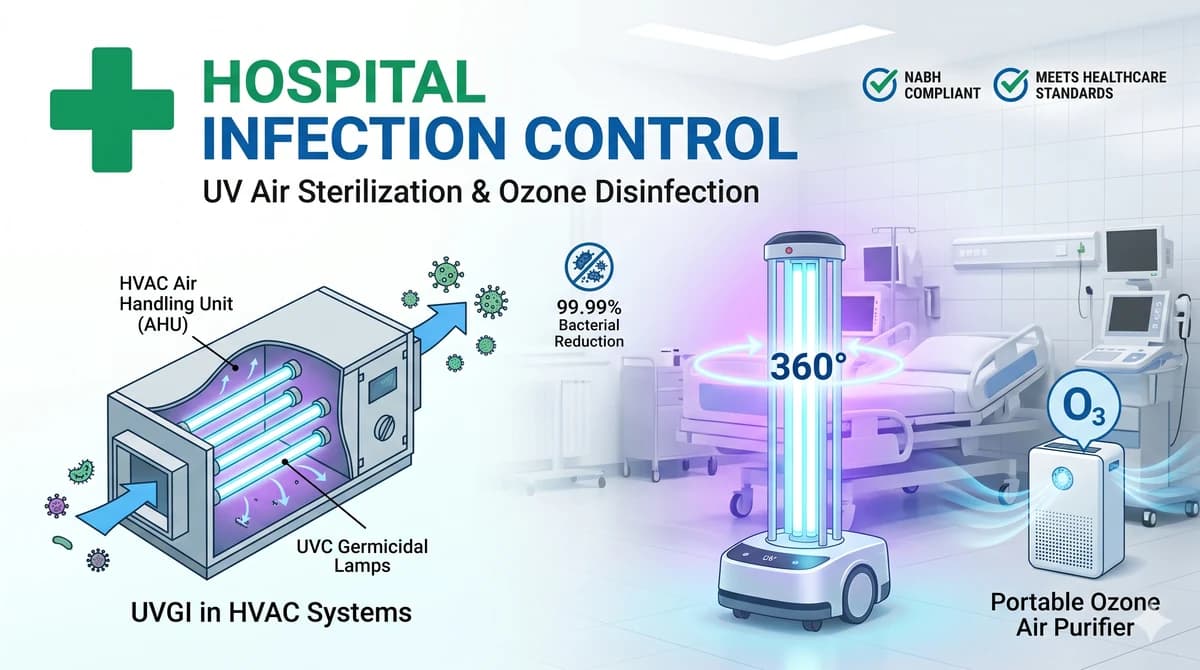
Hospital and Healthcare
NABH-aligned UV and ozone disinfection for hospital air, water, surfaces, and instrument sterilization

Rubber and Polymer Testing
IS:3400 / ISO 1431 / ASTM D1149 compliant ozone test chambers for rubber ozone cracking and ageing tests
Have a question about Stability Testing?
Talk to our engineers — free technical consultation
WhatsApp Us Now