
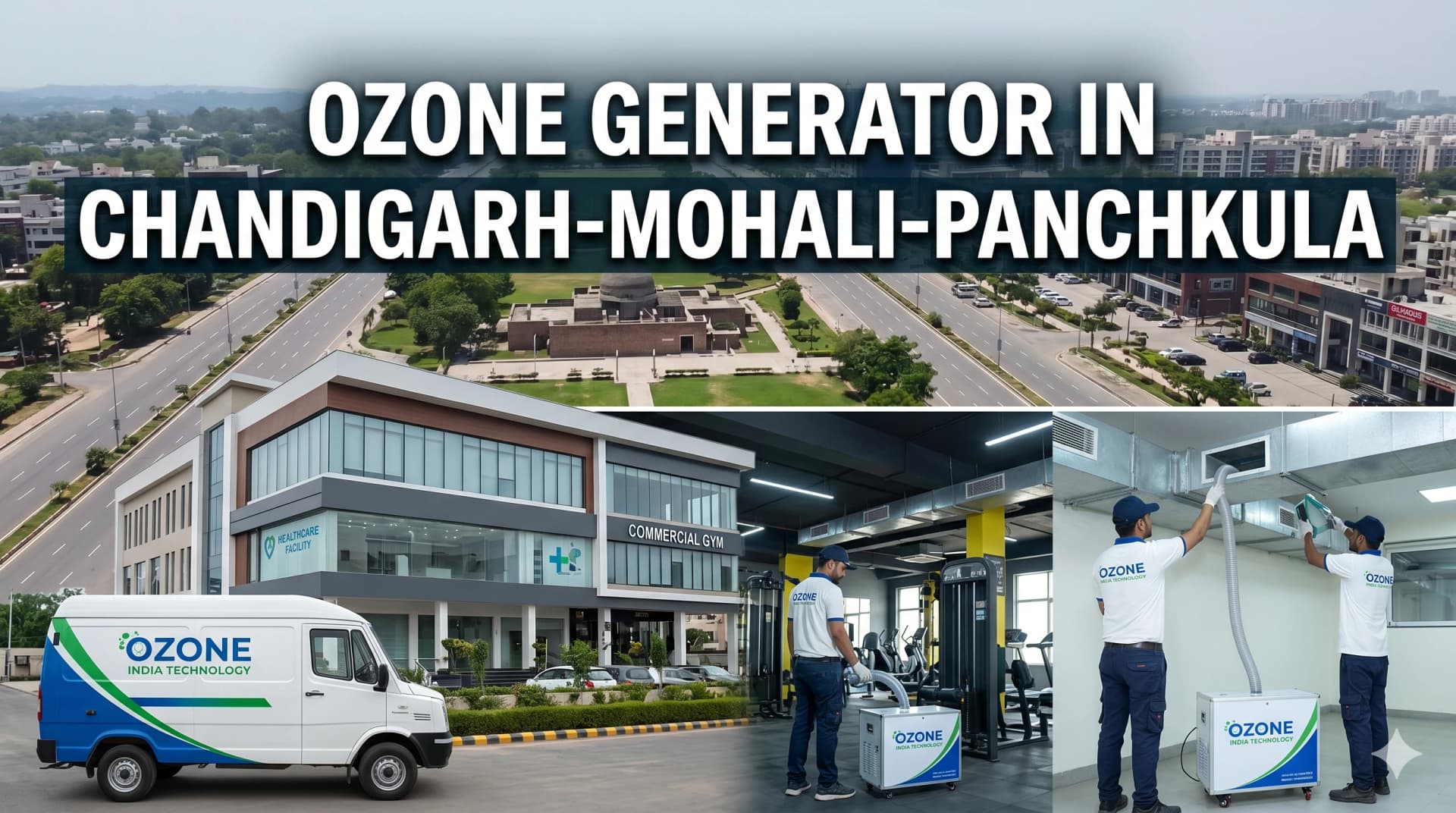
Ozone Generator in Chandigarh, Mohali and Panchkula — India's Tricity — addresses the unique water treatment demands of one of India's most planned and environmentally conscious urban agglomerations. The Chandigarh-Mohali-Panchkula Tricity houses India's fastest-growing pharmaceutical cluster (Mohali SSWEZ life sciences zone), a major IT/ITES sector (Mohali IT City, Panchkula IT Park), Sukhna Lake (Chandigarh's iconic Ramsar Wetland candidate), and the Ghaggar River — one of Punjab's most monitored rivers for industrial compliance. Ozone India Technology — India's CE-certified, ISO 9001:2015 manufacturer of industrial ozone generators — is headquartered in Greater Noida, 300 km from Chandigarh, with same-day site visit capability and next-day delivery. Contact our team at +91 96500 17943 for a free application consultation.
Water and Industrial Challenges in Chandigarh Tricity
Chandigarh — India's first planned city designed by Le Corbusier and a Union Territory of 1.2 million people — draws its water from Bhakra-Nangal Canal system and from the Sukhna Lake (11.5 km², a conservation reservoir in the Shivalik foothills). Sukhna Lake has been experiencing progressive siltation and algal bloom events — CPCB monitoring shows phosphorus levels at 0.08 to 0.12 mg/L (WHO eutrophication threshold: 0.05 mg/L) due to nutrient loading from the Sukhna Choe stream, which drains agricultural and semi-urban areas upstream.
Mohali (SAS Nagar, Punjab) — Chandigarh's fastest-growing satellite city — hosts the SAS Nagar SSWEZ (Special Economic Zone for Life Sciences), housing pharmaceutical and biotech manufacturers including Panacea Biotec, Lupin's Mohali plant, Intas Pharmaceuticals Mohali operations and over 30 smaller API and formulation manufacturers. PPCB (Punjab Pollution Control Board) classifies pharmaceutical units as Red Category, requiring OCEMS and quarterly audits. WHO GMP Schedule M purified water is mandatory for all licensed manufacturers.
The Mohali IT City — housing TCS, Infosys, Wipro, HCL and Accenture campuses — generates campus sewage from 50,000-plus daily employees requiring STP treatment. PPCB requires campus STP discharge for treated water reuse (for landscaping, toilet flushing) to meet CPCB's Sewage Treatment Standard: BOD ≤ 10 mg/L, TSS ≤ 10 mg/L, coliform ≤ 100 MPN/100 mL — achievable reliably only with ozone or UV tertiary disinfection.
Panchkula (Haryana) — the third city of the Tricity — houses Panchkula Industrial Area (Sector 25, 26) with light engineering, food processing and pharmaceutical units governed by HPPCB (Haryana State Pollution Control Board). The Ghaggar River — which flows from the Shivalik Hills through Panchkula and Ambala before entering Rajasthan — receives combined domestic and industrial effluent from the Tricity, and its water quality is a priority NGT monitoring point.
How Ozone Technology Addresses Chandigarh Tricity's Challenges
For Mohali pharma purified water, ozone at 0.05 to 0.2 mg/L in purified water distribution loops achieves WHO GMP bioburden below 100 CFU/mL, TOC below 500 ppb and conductivity within WHO GMP limits continuously. Ozone sanitisation eliminates the weekly chemical sanitisation cycle (typically using peracetic acid or sodium hypochlorite) that generates chemical waste requiring PPCB disposal management.
For Mohali and Panchkula campus STPs, ozone tertiary treatment at 5 to 8 mg/L after secondary biological treatment achieves CPCB's sewage reuse standard — enabling IT campuses to recycle 80 to 90 percent of campus STP output for landscaping and toilet flushing, reducing fresh water demand from Chandigarh Municipal Corporation supply.
For Sukhna Lake protection, ozone pre-treatment of Sukhna Choe stream inflow at 1 to 2 mg/L would destroy incoming algal bloom precursor nutrients, reduce BOD and coliform loading, and prevent cyanobacterial bloom establishment during June-September monsoon runoff period — protecting the lake's ecological integrity and recreational water quality.
Mohali IT Campus STP — BOD and Coliform Removal for Water Reuse (mg/L / MPN)
Key Applications in Chandigarh Tricity
Pharmaceutical Purified Water — Mohali SSWEZ Life Sciences
Mohali SSWEZ's pharmaceutical cluster requires WHO GMP purified water continuously. Ozone India Technology supplies 2 to 10 g/hr pharmaceutical-grade ozone sanitisation systems for purified water loops in Panacea Biotec, Lupin Mohali, Intas and SSWEZ tenant pharmaceutical plants. Complete CDSCO Schedule M documentation with CE certification. Next-day delivery from Greater Noida.
IT Campus STP — Mohali IT City and Panchkula IT Park
TCS, Infosys and Wipro campus STPs require ozone tertiary treatment for PPCB/HPPCB sewage reuse compliance. Ozone India Technology supplies 10 to 50 g/hr campus STP ozone systems with dissolved ozone monitoring, automatic dosing and PPCB-compatible data logging for corporate sustainability reporting.
Sukhna Lake Catchment Protection
Ozone treatment of Sukhna Choe stream inflow (3 to 5 MLD) at 1 to 2 mg/L applied dose before lake entry would reduce phosphorus-associated algal bloom risk and destroy incoming E. coli. Ozone India Technology provides compact stream-side ozone dosing systems for Chandigarh Administration's lake protection programme.
Punjab Agricultural Water — Mohali District Vegetable Farms
Mohali district's vegetable supply for Chandigarh uses groundwater and canal water for irrigation. Ozone India Technology supplies compact 2 to 5 g/hr ozone irrigation water disinfection systems for produce farmers — reducing pesticide-contaminated irrigation water risk and meeting FSSAI food safety requirements for fresh produce sold to Chandigarh institutions.
Why Indian-Manufactured Ozone Technology Suits India
Our Greater Noida facility is 300 km from Chandigarh — 4 to 5 hours by road via Yamuna Expressway and NH-44 or Delhi-Chandigarh NH-44. In-stock systems delivered next day. Our engineering team is available for Chandigarh Tricity site visits within 24 hours. PPCB, HPPCB and Chandigarh Administration-aligned compliance documentation. CE-2621A and ISO 9001:2015 accepted by all regulatory bodies. Factory-direct pricing 30 to 40 percent below European alternatives.
Compliance and Standards in Chandigarh Tricity
PPCB (Punjab PCB) governs Mohali industries; HPPCB (Haryana PCB) governs Panchkula; Chandigarh Administration's Environment Cell governs the Union Territory. CPCB Sewage Treatment Standard for reuse: BOD ≤ 10 mg/L, TSS ≤ 10 mg/L, coliform ≤ 100 MPN/100 mL. CDSCO Schedule M for pharma purified water. BIS IS 10500:2012 for drinking water from Sukhna Lake.
Mohali Pharma Zone — Purified Water Bioburden Compliance Before/After Ozone (CFU/mL)
Frequently Asked Questions
Does Ozone India Technology install in the Chandigarh Tricity?
Yes. With our Greater Noida facility 300 km away and a team available for next-day site visits, Chandigarh Tricity is among our closest markets. We have installed pharmaceutical purified water, campus STP and industrial ETP ozone systems across Punjab, Haryana and Himachal Pradesh.
What PPCB documentation is required for ozone system installation in Mohali?
For Mohali pharmaceutical units: existing Consent to Establish/Consent to Operate covers installation of ancillary ETP equipment including ozone. The ozone system is submitted as a "change in pollution control equipment" form to PPCB Mohali Regional Office with CE certificate and ISO 9001 documents. Ozone India Technology prepares all required documentation.
Can Sukhna Lake benefit from ozone treatment of stream inflows?
Yes. Sukhna Choe stream — the primary inflow to Sukhna Lake — carries nutrient-rich runoff during monsoon that triggers algal blooms. Ozone at 1 to 2 mg/L applied at the lake inlet would destroy BOD, E. coli and algal cells before they establish in the lake. Chandigarh Administration can evaluate a 3 MLD pilot ozone treatment system for Sukhna Choe for the June-September bloom season.
What is the payback on an ozone purified water system for a Mohali pharmaceutical plant?
Replacement of weekly chemical sanitisation (peracetic acid: Rs 15,000 to 30,000 per week; disposal cost: Rs 5,000 to 10,000 per week) with continuous ozone sanitisation saves Rs 25,000 to 40,000 per week — Rs 13 to 20 lakhs per year. For a Rs 8 to 15 lakh ozone system investment, payback is 6 to 14 months.
How to Get an Ozone System for Chandigarh Tricity
Contact us:
- Phone / WhatsApp: +91 96500 17943
- Email: [email protected]
Next-day delivery, on-site support within 24 hours, PPCB-aligned documentation.