
What Is an Ozone Treatment Machine?
An ozone treatment machine is a corona discharge generator that produces ozone from dry air or oxygen and applies it to water, air, surfaces, or materials to destroy pathogens, remove colour, oxidise organic contaminants, and eliminate odour.
The term covers a wide range of equipment — from compact 2g/hr portable units to 10kg/hr municipal treatment plants. What they share is the same operating principle: high-voltage electrical discharge across a dielectric gap converts oxygen (O₂) into ozone (O₃), which is then applied to the treatment medium.
Ozone Treatment Machine — Output Range by Application Type
Types of Ozone Treatment Machines
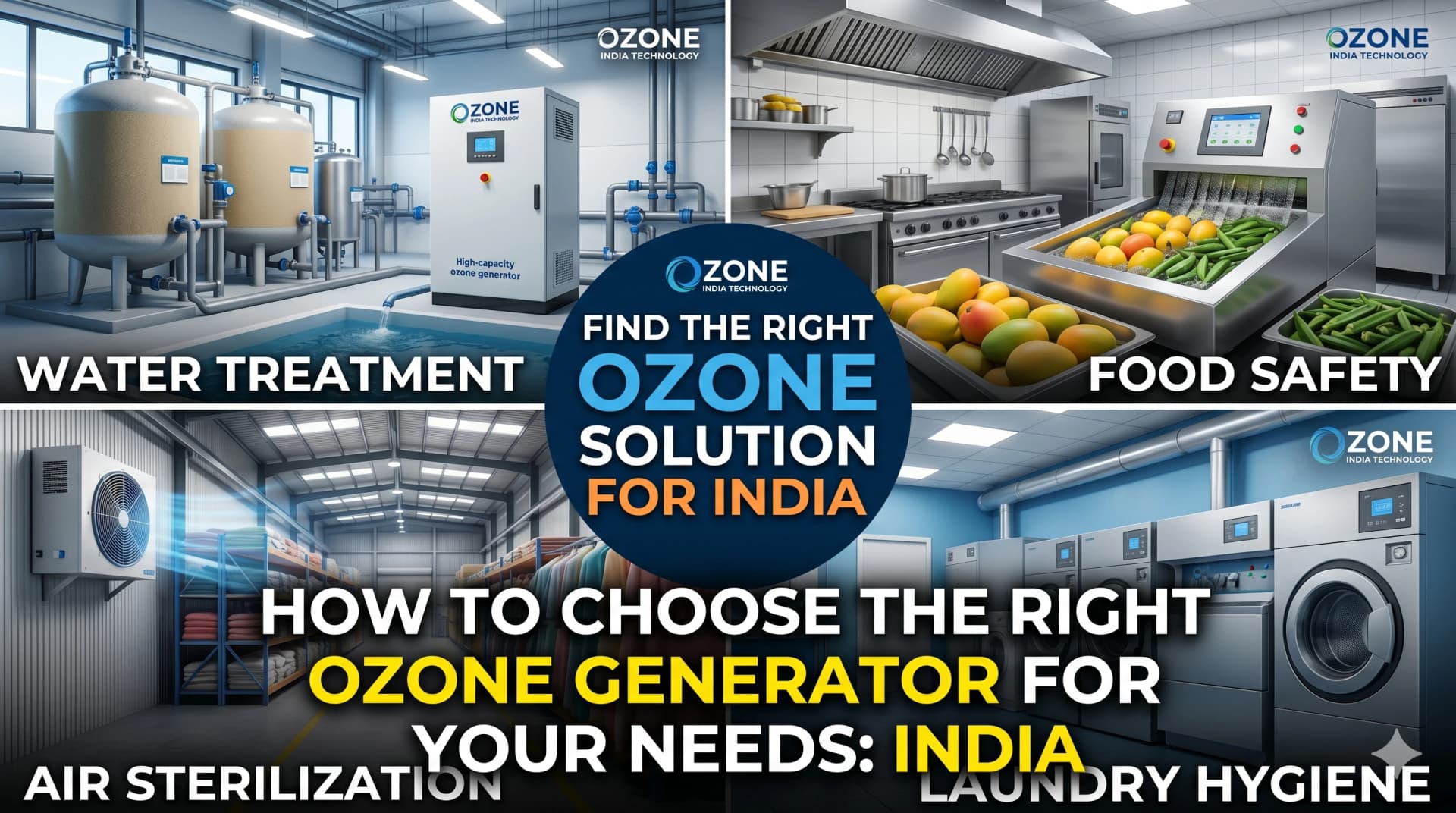
1. Water Treatment Machines
The most common type in India. Ozone is dissolved into water through a venturi injector, bubble diffuser, or static mixer. Applications:
- Drinking water disinfection: 0.2–0.5 mg/L dose, IS:14543 compliance
- ETP colour removal: 10–30 mg/L dose, CPCB discharge compliance
- STP tertiary treatment: 5–10 mg/L dose, BOD/COD polishing
- Pharmaceutical PW loops: 0.1–0.2 mg/L continuous, WHO GMP
- Cooling tower: 0.2–0.5 mg/L basin, Legionella control
Capacity range: 2g/hr (small RO plant) to 10kg/hr (municipal).
2. Air Treatment Machines
Ozone is circulated through air in a room, HVAC duct, or cold storage space. Applications:
- Cold storage odour control: fruit and vegetable storage, meat processing
- Room shock treatment: hotel rooms, hospitals, crime scenes
- Industrial odour control: sewage pump stations, rendering plants
- HVAC duct sanitation: mould and biofilm control in air handling units
Capacity range: 200mg/hr (room purifier) to 50g/hr (large cold storage).
3. Food Safety Machines
Purpose-designed ozone treatment machines for food contact applications. Applications:
- Fruit and vegetable washing: 0.5–3 mg/L ozone wash water, removes pesticides and pathogens
- Seafood processing: 0.2–1 mg/L wash water for shelf life extension
- Poultry and meat processing: surface decontamination
- Packaging and conveyor sanitation: surface ozone application
Construction: SS304/316 food-grade, FSSAI compliant.
4. Test Chamber Machines (Ozone Test Chambers)
Precision ozone treatment machines that maintain controlled ozone concentration (10–200 pphm) and temperature (20–70°C) for material ageing tests. Applications:
- Rubber ozone cracking test: IS:3400 Part 6, ASTM D1149
- Cable insulation ageing: IEC 60811
- Automotive seal testing: SAE J2236
- Polymer material qualification: automotive, aerospace, medical
These are instrument-grade machines requiring calibrated ozone generation and UV photometric monitoring.
How to Choose an Ozone Treatment Machine
Selection Criteria Weight by Application Type
Step 1 — Define the Application
Different applications have completely different requirements. A water treatment machine and an air treatment machine are not interchangeable. Confirm: What medium are you treating? What is the contamination load? What is the target output quality?
Step 2 — Calculate Required Output
Water: Dose (mg/L) × Flow (m³/hr) = Ozone demand (g/hr)
Air: Volume (m³) × Target concentration (mg/m³) ÷ Contact time (hr) = Output (mg/hr)
Food safety: Throughput (kg/hr) × empirical dose → consult OZ India Technology
Step 3 — Verify Feed Gas Requirements
- Ambient air systems: require feed air drying to −40°C dew point minimum
- Oxygen systems: require PSA oxygen generator or LOX supply
- Humid air entering the ozone cell without drying causes rapid cell degradation
Step 4 — Check Material of Construction
All ozone-contact materials must be ozone-resistant:
- Stainless steel: SS316L or SS304L (not carbon steel)
- Pipes: PVDF or Teflon (not rubber, not PVC)
- Gaskets: Viton or EPDM (not standard rubber)
Step 5 — Confirm Certifications
For industrial procurement: CE certification (number + issuing body). For food applications: FSSAI recognition. For pharma: WHO GMP documentation support. For government tenders: MSME/UDYAM registration.
Ozone Treatment Machine Price Guide — India 2026
| Capacity | Type | Indicative Price |
|---|---|---|
| 2g/hr portable | Air/water | ₹12,000–20,000 |
| 5g/hr light industrial | Water/air | ₹28,000–45,000 |
| 10–25g/hr industrial | Water treatment | ₹60,000–1,20,000 |
| 30–50g/hr heavy industrial | ETP/STP | ₹1,50,000–3,00,000 |
| 75–350g/hr large scale | Municipal, industrial | ₹4,00,000–12,00,000 |
| 400g/hr–1kg/hr municipal | Drinking water, large STP | ₹8,00,000–22,00,000 |
| 1kg/hr–10kg/hr mega plant | Large municipal/industrial | On request |
Prices are factory-direct from Ozone India Technology — no importer or distributor margin. Complete systems (generator + contact tank + venturi + destructor + monitor) are quoted as packages.
Ozone India Technology — Ozone Treatment Machines
Ozone India Technology (Greater Noida, UP) manufactures the complete range:
Certifications: CE-2621A, ISO 9001:2015 UQ-270426AD1, ISO 12100, RoHS, UDYAM-UP-29-0072870
Capacity range: 2g/hr → 10kg/hr, all application types
Support: Application sizing, site commissioning, operator training, 12-month warranty, spare parts stock
Contact: +91 96500 17943 | WhatsApp | [email protected]
Conclusion
An ozone treatment machine covers a wide range of equipment types — water, air, food, and test chamber — each sized and constructed differently. The selection process starts with application definition and ozone dose calculation, then moves to feed gas specification, material compatibility, and certification verification. Ozone India Technology's engineering team provides free application-specific sizing and quotation within 2 hours for any ozone treatment machine requirement in India or export.